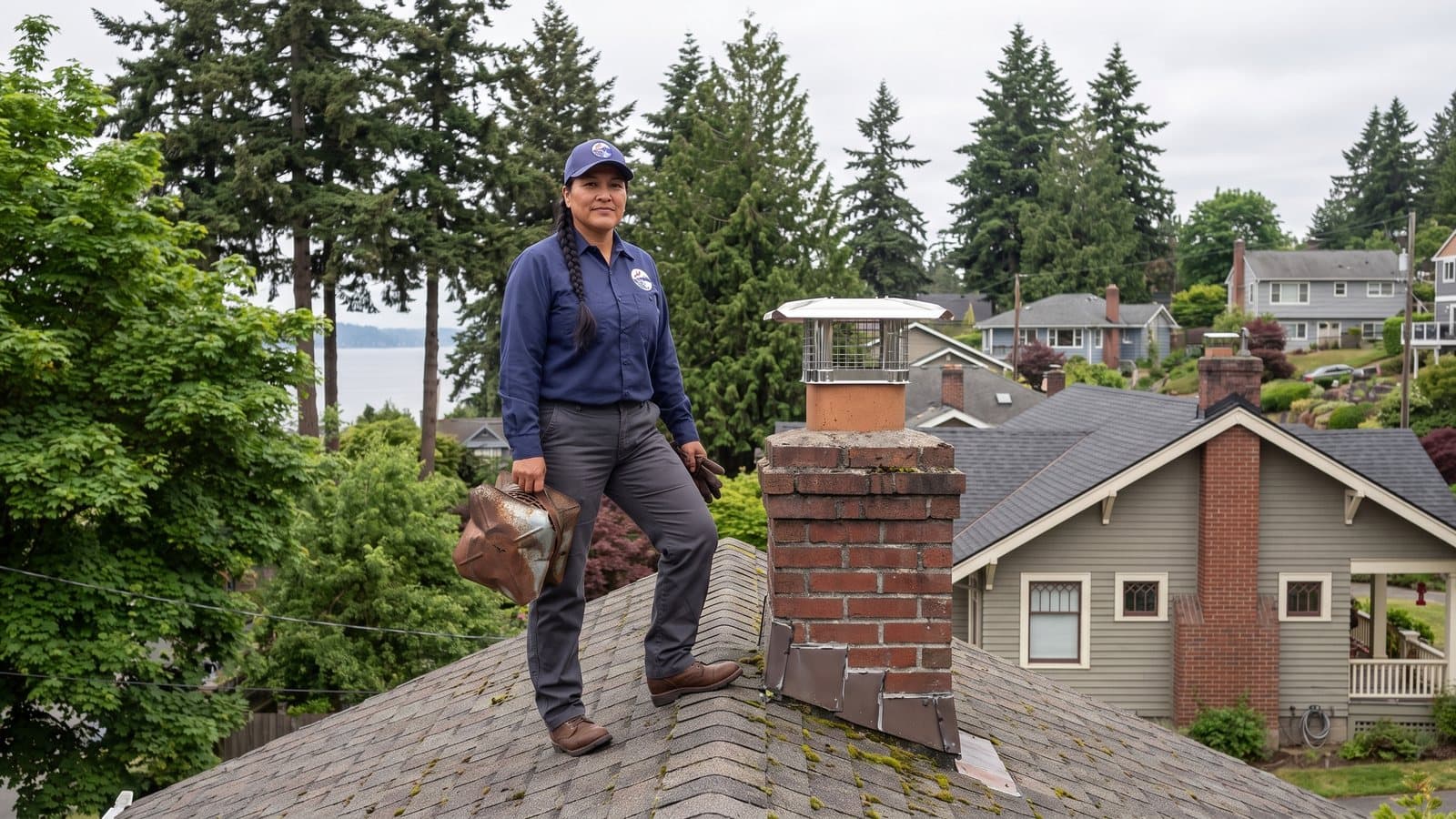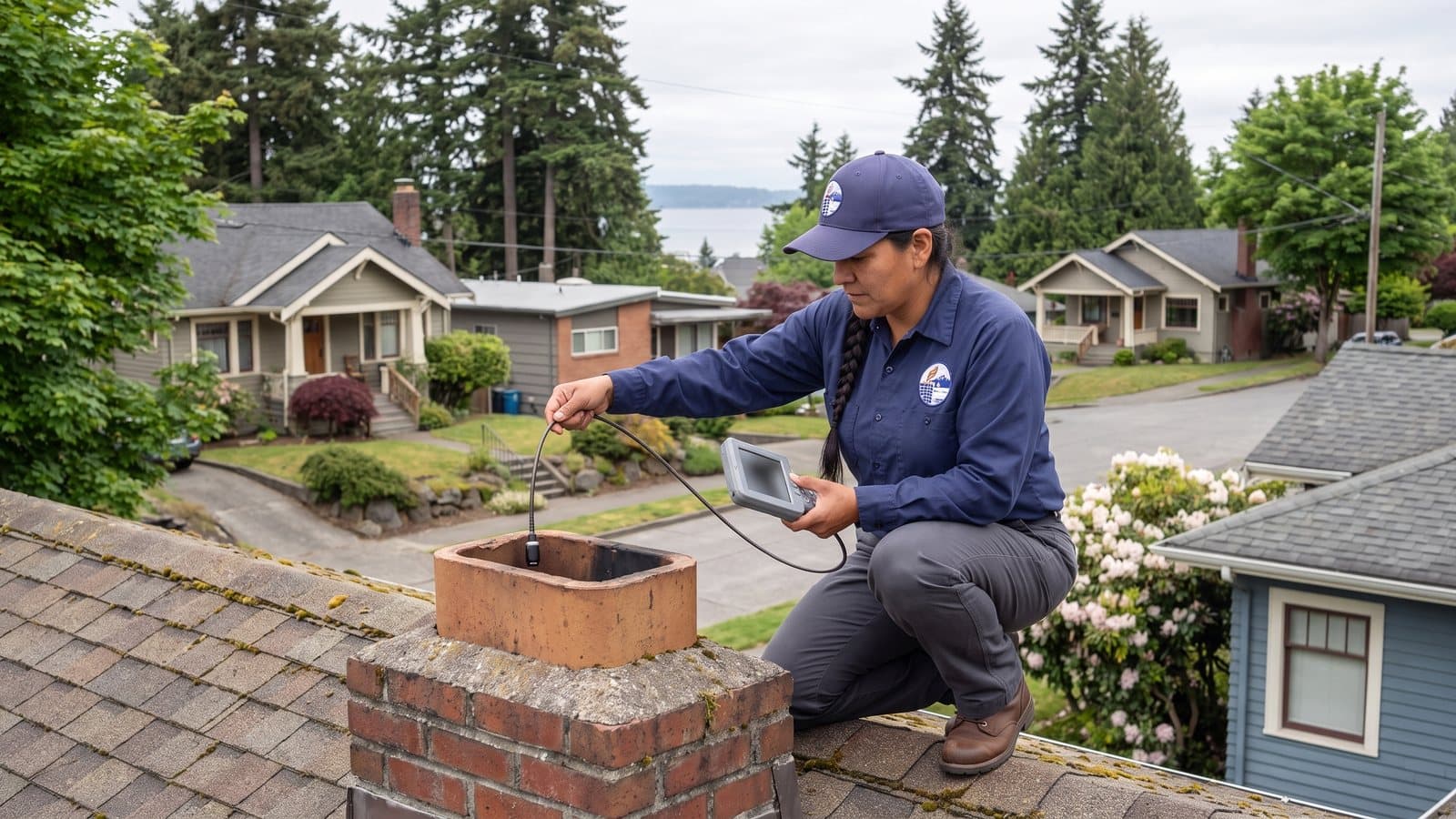
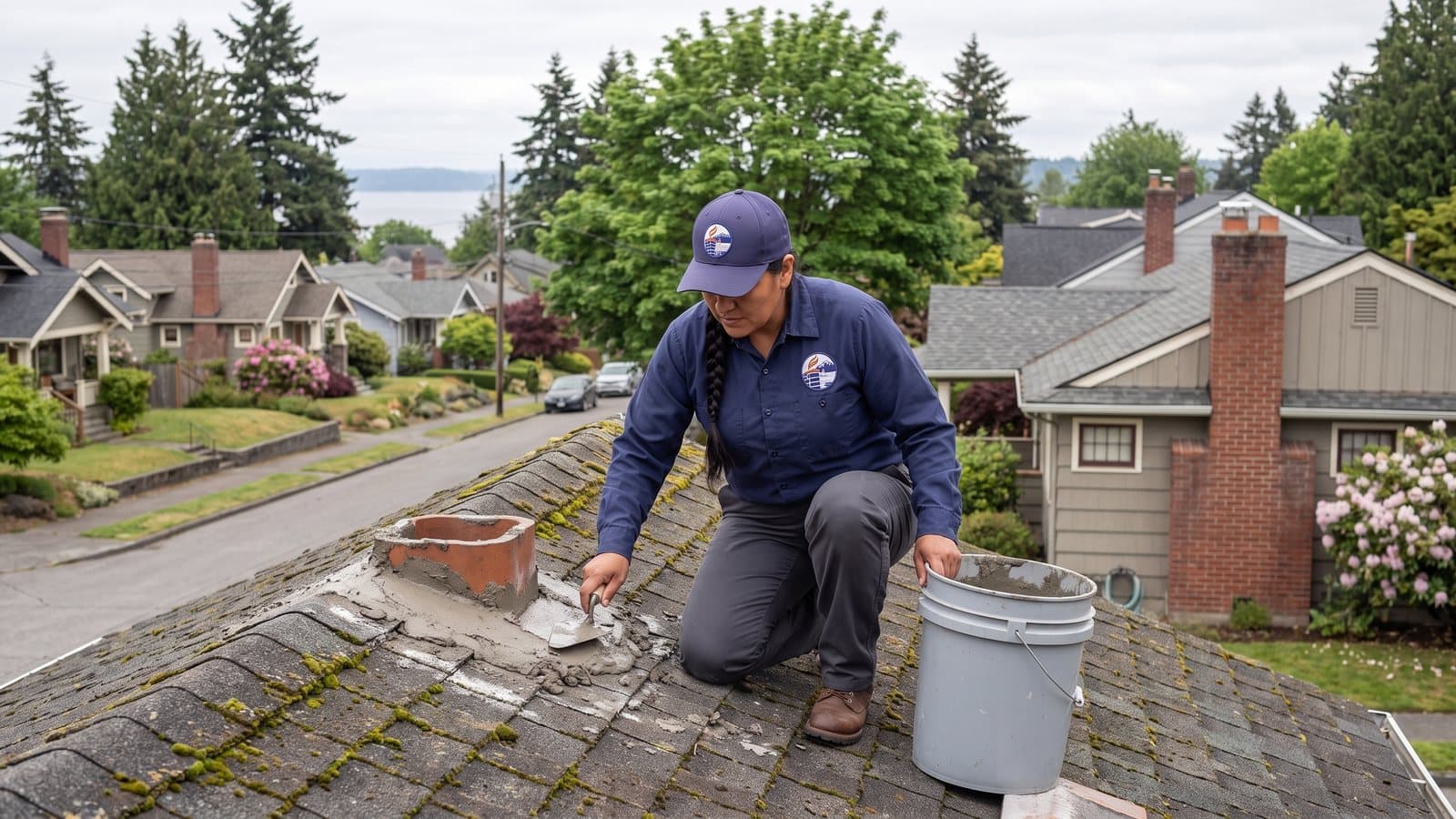
Crown repair and waterproofing answer two different water problems, and a West Seattle chimney is worth checking for both. A crown is the concrete or mortar cap sealing the top of a brick stack around its flue. When it cracks, rain drops straight into the brickwork below. Waterproofing is a breathable repellent brushed or sprayed onto the brick faces and mortar joints, so that they take in less of the rain that reaches them from the side. This guide sorts out which job a chimney needs, what Seattle's code expects of a crown, and which months suit the work.
What the code asks of a crown
The 2021 Seattle Residential Code deals with the top of a masonry chimney in one short passage, R1003.9.1. The crown is to be made of concrete, metal or stone. It has to be pitched, so that water leaves it instead of sitting on it. It needs a drip edge, which throws the runoff clear of the brick. And wherever a flue liner comes up through the slab, the code wants a caulked bond break between the two, because the liner gets hot and moves while the crown stays put.
Compare that list with what is on your own stack. A thin, flat layer of bricklaying mortar, set tight against the flue tile and flush with the outer brick, has none of the four features. It may have served for decades, and an older house that predates today's code is not at fault for having one. It is simply the kind of crown that deserves a close look every year.
Rain by the month, and frost by the night
The long-running weather record nearest the peninsula puts a normal year's precipitation at 38.29 inches. November brings 6.11 inches, December 5.80 and January 5.77, against 0.75 in July. WeatherSpark's profile of the city dates the wetter season from October 10 to April 30. Those are citywide figures; nobody publishes a separate rain record for the peninsula.
Cold matters as much as rain. At the same station the overnight low touched 32°F or below on 33.2 days in an average year, while the daytime high stayed at or under freezing on only 2.7. Put plainly, a cold spell here is mostly a frost at night and a thaw the next day. Water sitting in a crown crack or soaked into a brick face goes through that cycle again and again, and a crack that was a hairline in October can be wider by March.
The practical consequence is a calendar. Crown mixes and repellents both need dry masonry and a dry spell to cure, so we plan this work for the summer months and the first weeks of fall, before the rain returns.
Crown repair or waterproofing: reading the signs
Most of these signs can be seen from the yard with binoculars. The table pairs each one with its usual source and with the work that addresses it.
Moss gets its own line because of where we are. OSU Extension, writing about roofs, treats moss as a fact of life in the wet Northwest and notes that it holds debris and keeps the surface under it wet for longer. Seattle's study of windstorm hazards counts the peninsula among the most heavily wooded parts of the city, and a chimney face shaded by tall firs dries slowly.
| What you see | Where the water is likely getting in | What addresses it |
|---|---|---|
| Cracks across the crown, or a gap around the flue tile | Through the top of the stack | Crown repair, or a new crown if the slab is broken up |
| A flat crown flush with the brick, no overhang | Runoff sheeting down the faces | A new crown with slope and drip edge |
| White powdery deposits on the brick | Water passing through the masonry and evaporating | Find and repair the entry point, then apply repellent |
| Brick faces flaking while the joints look sound | Brick absorbing rain, then freezing | Replace the damaged brick, then waterproof |
| Mortar joints recessed or open | Through the joints | Repointing first; repellent does not close an open joint |
| Moss on the shaded side | A surface that stays wet | Gentle cleaning, a check of the joints, then repellent |
| A ceiling stain next to the chimney | Crown, flashing or masonry | An inspection to tell the three apart |
What a repellent does and does not do
A masonry water repellent lowers the amount of rain the brick and mortar take in. The products we use are breathable: liquid water is slowed on the way in, and vapor already inside the wall can still leave. Paint, or any sealer that dries to a film, works the other way and traps moisture behind it, which is why we do not use them on a chimney.
The treatment has limits. It fills no cracks, rebuilds no crown and replaces no mortar. Applied over defects, it hides them for a season. The order therefore never changes: repair the crown, repoint what is open, let everything dry, then treat.
What the two jobs run
Our waterproofing is $320 to $795 per chimney, depending on its size and on how the faces are reached. Crown work is priced with our masonry repairs, which start at $475. The visit that establishes which of the two you need is the inspection. It is billed at $99 plus tax a chimney, and those $99 come off the bill once you accept the quote.
Published figures from others give a sense of the Seattle market. Mad Hatter Chimney Sweep lists waterproofing at $200 to $500. Emerald City Chimney, a company based outside the city that includes Seattle in its service area, shows crowns starting at $550 plus tax, depending on chimney size and access. Homeyou's Seattle page gives $150 to $300 for crown damage repair; that number is a modeled estimate, not a quote anyone received.
Frequently asked questions
How do I know the water is coming through the crown and not the flashing?
From the living room you usually cannot. A stain on the ceiling beside the chimney can start at the crown, at the metal where the stack meets the roofing, or in the brick itself. Separating the three takes a look at the top of the stack, at the flashing and, where there is access, at the masonry in the attic. That is what the inspection visit is for.
Can a repellent be applied over a cracked crown to save the repair?
No. A water repellent soaks into sound brick and mortar and makes them absorb less. It does not bridge a crack, and it does nothing for a slab that lets water in around the flue tile. Repairs come first, and the repellent goes on afterwards, on dry masonry.
Does crown or repointing work need a permit in Seattle?
Repointing is named in the permit exemptions of Seattle's residential code (R105.2), provided the building envelope is left unchanged; SDCI's page on remodels repeats it. A crown rebuild or a larger job is not spelled out there, so we ask SDCI ahead of time if a permit is due. A designated city landmark is a separate case: any exterior change needs a Certificate of Approval first.
Is waterproofing a one-time job?
No. The repellent wears with weather. One Seattle company, Mad Hatter Chimney Sweep, writes that these products last 5 to 10 years and advises reapplying on a 5-to-7-year cycle around Seattle. We look at how the brick sheds water at each visit instead of going by the calendar alone.
Sources
- Seattle Residential Code 2021, Chapter 10 (SDCI) — accessed October 4, 2026
- SDCI — R105.2, work exempt from permit — accessed October 4, 2026
- WRCC — monthly climate summary, station 457473 — accessed October 4, 2026
- WRCC — temperature summary, station 457473 — accessed October 4, 2026
- WeatherSpark — year-round weather in Seattle — accessed October 4, 2026
- OSU Extension — controlling roof moss — accessed October 4, 2026
- Seattle hazard analysis — windstorms chapter — accessed October 4, 2026
- Mad Hatter Chimney Sweep — waterproofing page — accessed October 4, 2026
- Emerald City Chimney — price list — accessed October 4, 2026
- Homeyou — chimney repair, Seattle estimates — accessed October 4, 2026
Related services