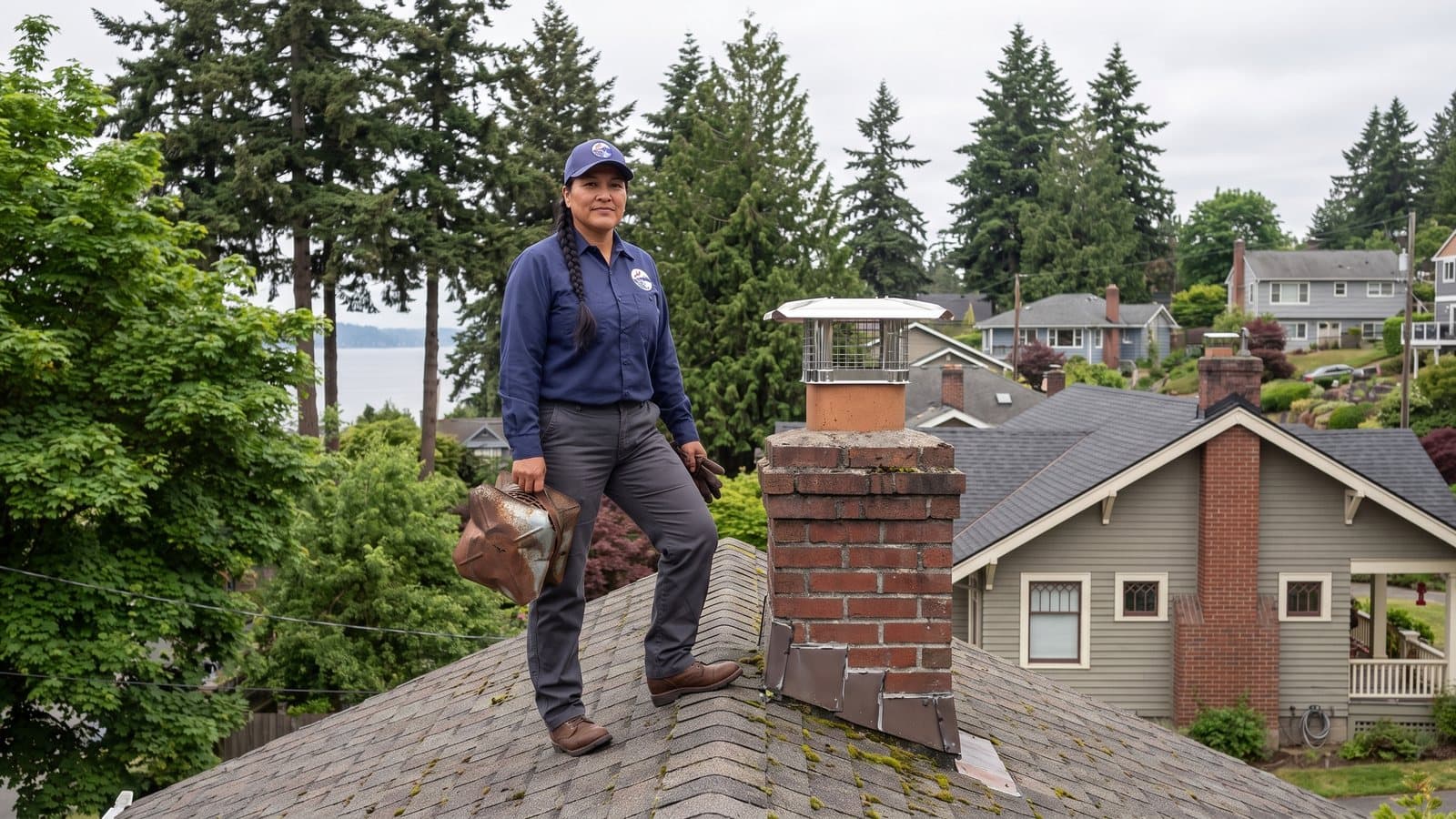
There is no honest calendar answer. A chimney cap is replaced when its condition says so, not after a set number of winters, and nothing we have read publishes a service life for caps on the West Seattle peninsula. What can be stated is what the cap is supposed to do under Seattle's code, what the local weather and tree cover throw at it, and which findings mean the cap has stopped doing its job. Look at it once a year, and after any storm that brings branches down.
The job description, as Seattle's code writes it
Two short paragraphs of the 2021 Seattle Residential Code describe the hardware at the flue outlet. Under R1003.9.2, a spark arrestor's net open area must be no smaller than the flue outlet's multiplied by four. Its screen must resist heat and corrosion as well as 19-gage galvanized steel or 24-gage stainless steel does. Openings in the mesh must pass a 3/8-inch ball yet block a 1/2-inch one. Finally, it must come off when the flue needs cleaning.
R1003.9.3 applies the same fourfold open-area rule to a rain cap. The reason is draft. A lid set too low over the flue, or a screen too fine for the opening, chokes the exhaust even when it is brand new.
A cap that meets those lines keeps rain, animals and embers where they belong. A cap that no longer meets them is due, whatever its age.
What works against a cap on the peninsula
Wind comes first. Sheltered as the Sound is, Seattle's hazard analysis allows for 60 to 70 mph sustained and 90 mph in gusts, and it adds that moving air picks up speed crossing hills and ridges. The Seattle Landslide Study draws the peninsula as twin ridges aligned north-south, Longfellow Creek in the trough, so a good share of the peninsula's rooftops sit on exactly that kind of ground. WeatherSpark places the windier part of the year between October 15 and April 24, with December the windiest month.
Trees come second. The same city analysis explains why the peninsula ranks high for wind damage: it is one of the most wooded districts in Seattle, and it is trees coming down, more than the wind itself, that break things. A limb does not have to be large to bend a lid or tear a screen loose from its band.
Then there is plain use. A screen over a wood-burning flue collects soot, and a screen under conifers collects needles. Either one can close the mesh that the code wants open.
Replace, repair or leave alone
This is the list we work through on the roof. Not every finding means a new cap.
One point on the last row: a single lid spanning several flues has to respect the open-area rule for each of them, which is why multi-flue caps are measured and made to fit instead of taken off a shelf.
| Finding | What it means | What we do |
|---|---|---|
| Screen clogged with soot or needles, metal sound | Draft is restricted | Clean the screen; keep the cap |
| Fasteners loose, cap shifted on the tile | It may leave in the next gale | Reset and refasten |
| Screen torn or pulled from its frame | Birds and embers can pass | Replace the cap |
| Rust through the lid or the band | Rain reaches the flue; the metal is spent | Replace the cap |
| Lid bent down toward the flue | Open area below the code's fourfold rule | Replace the cap |
| No cap at all | The flue is open to rain and animals | Fit a cap sized to the flue |
| Cap too small or too low for the flue it sits on | Draft was choked from day one | Replace with the right size |
| One cap over several flues, sagging or split | Each flue's outlet is affected | Measure and fit a new multi-flue cap |
Choosing the replacement
Start from the flue, not from the old cap. We measure the tile or the liner outlet, check whether it stands proud of the crown, and count the flues. The cap is then sized so its screen leaves the required open area and its lid sits high enough over the outlet.
For the metal, the code accepts a screen equal to 19-gage galvanized or 24-gage stainless. We fit stainless steel as our standard. The crown under the cap gets looked at on the same trip, since a cap bolted to a broken crown is not secure and a sound cap does nothing for water entering through the slab around it.
What a new cap runs
Installed, our caps run $235 to $850: a stock stainless cap over a single flue sits at the bottom of that range; several flues under one lid, or a made-to-measure cap, are at the high end.
Three published figures for comparison. A company with an address on SW Admiral Way, Jason L. Chimney Co., lists cap installation at $200 to $500 on its pricing page. Mad Hatter Chimney Sweep, in Seattle, prices a standard cap on one flue, installed, at $200 to $350. Emerald City Chimney, based outside the city and serving it, prices its standard stainless cap, installed, at $199.95 plus tax.
If you are not sure the cap is the problem, the starting point is our inspection: $99 plus tax a chimney, and once you say yes to the quote, that fee is subtracted from it.
Frequently asked questions
Is a spark arrestor required on every chimney?
The passage of the Seattle Residential Code we rely on, R1003.9.2, does not order one onto every chimney. It sets the specification for a spark arrestor where one is fitted: enough open area, a screen of the stated gauge and mesh, and a design that comes off for cleaning. A cap that carries a screen has to meet that specification.
How can I check my cap without going on the roof?
Use binoculars from the yard or the street, on a dry day. Look for a lid that sits crooked, rust streaks on the crown or the brick below, a screen that looks solid black instead of open, and anything green or twiggy inside the mesh. If the cap is gone altogether, you will see the bare flue tile. Leave the ladder work to the visit.
My cap came off in a windstorm. Can it wait until spring?
We would not wait. The wetter season in Seattle runs from about October 10 to April 30 on WeatherSpark's profile, and an open flue takes rain directly for all of it. An uncapped flue is also open to birds and to falling needles and twigs. Have the flue checked for water and debris when the new cap goes on.
Does a factory-built chimney take the same cap as a brick one?
No. A metal factory-built chimney is sold and listed as a complete assembly, top included. On such a chimney the code permits a decorative shroud solely if the listing of that very system includes it. We identify the make before ordering anything, and we do not fit a masonry-style cap to a metal chimney.
Sources
- SDCI — 2021 Seattle Residential Code, chimneys chapter — accessed October 4, 2026
- Seattle OEM — windstorm hazard analysis (2014) — accessed October 4, 2026
- Seattle Landslide Study, Volume 1 — accessed October 4, 2026
- WeatherSpark — Seattle climate profile — accessed October 4, 2026
- Jason L. Chimney Co. — pricing page — accessed October 4, 2026
- Mad Hatter Chimney Sweep — cap installation — accessed October 4, 2026
- Emerald City Chimney — prices — accessed October 4, 2026
Related services