Chimney safety
Three earthquakes in one lifetime have each singled out the brick chimneys of West Seattle. Add a long wet season, winter windstorms and burn bans, and a chimney here has more to answer for than most. This guide takes the risks one at a time and names the source of every figure.
Age is the first thing to know about a chimney, and the Census gives a rough picture. Take the Census ZIP code area around Gatewood, Fauntleroy and the southern Seaview waterfront: 30.1 percent of its housing units date from 1939 or before. Seattle overall stands at 22.8 percent. The median year built there is 1960; the citywide median is 1976. A ZIP code area is not a neighborhood, and the Census counts neither chimneys nor fireplaces, so the numbers describe the houses, not what stands on their roofs.
A house from before the war may still carry its original brick stack. If yours does, the earthquake record below is the part of this guide to read first.
Earthquakes
According to USGS authors, the deep earthquakes of 1949, 1965 and 2001 each damaged unreinforced brick chimneys in the Seattle area, and each left pockets of heavy damage in West Seattle.
1949
About 30 seconds of shaking. HistoryLink reports roughly 10,000 chimneys needing repair across western Washington. In Admiral, the 1893 brick Lafayette School lost three gables, which dropped their bricks onto the sidewalk; it happened during spring vacation, and only the gym addition could be saved.
1965
About 45 seconds, starting at 8:29 a.m. Surveyors afterward covered 188 blocks on the peninsula. Of the 5,005 chimneys they counted, 1,712 were damaged: 34 percent. Alki Beach was not among the surveyed blocks; there, by HistoryLink's account, reports had almost all chimneys down. At Alki School a 60-foot stack fell onto the boiler room.
2001
The Nisqually earthquake struck at 10:54 a.m., 52 kilometers down, by the Pacific Northwest Seismic Network's account. USGS-published researchers then checked roughly 60,000 chimneys over some 50 square kilometers of greater Seattle and found 1,556 visibly damaged, with West Seattle the strongest cluster.
What the surveys found
The 2001 survey by Booth, Wells and Givler is the reason so much is known. Their paper concludes that the damage in West Seattle could not be explained by distance from the epicenter, by soft ground, by terrain or by the direction a slope faces. The worst zones followed the strands of the Seattle fault zone already on the map; past the edge of the zone, the count of broken chimneys fell sharply in the space of one or two blocks. The same paper recalls that damage had been mapped here after 1965.
A USGS simulation offers a mechanism. It models a fold in the bedrock roughly 200 meters across, about 300 meters below the surface, that focuses seismic waves coming up from the south. The page cites recordings from 2001 in which one station registered nearly three times the peak horizontal ground acceleration of another, and notes that the simulated zone of amplification broadly matches the pocket of chimney damage reported in 1965 and 2001. The published abstracts do not say which streets sit over the fold, so we name none.
Region-wide figures show how much of the 2001 damage was chimneys. USGS Open-File Report 03-211 states that a third of the 30,000 houses FEMA inspected after Nisqually had chimney damage. EERI's reconnaissance team found that wood-frame houses performed well overall, their damage mostly limited to the chimney.
After the shaking
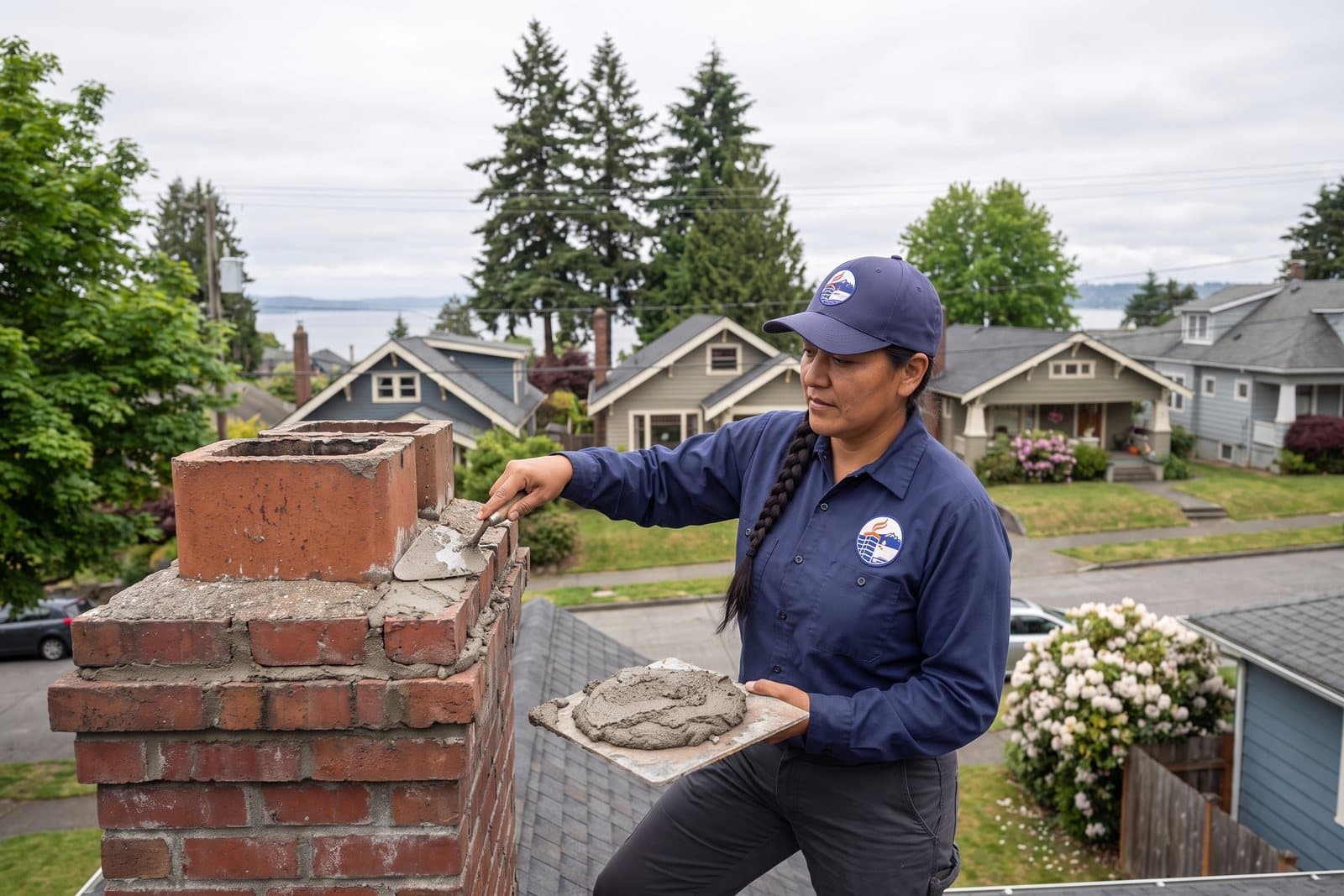
FEMA's recovery advisory on earthquake-damaged masonry chimneys identifies the stacks most likely to come down: old, unreinforced, with deteriorated mortar. It warns that a like-for-like rebuild remains just as vulnerable, and recommends partial or full removal in favor of a metal flue or an insert inside light-frame construction. The advisory adds that a building permit is always needed for that work.
The Seattle Residential Code sets the steel for a masonry chimney that is built new or rebuilt. In Seismic Design Categories D0, D1 and D2, a chimney up to 40 inches wide needs four continuous No. 4 vertical bars and strap anchorage at every floor, ceiling or roof line more than 6 feet above grade. We did not find the category of a given address on a public page; SDCI is the office to ask. After any earthquake you feel, start with a chimney inspection before the next fire, and let the photographs decide whether chimney repair or relining comes next.
Every twelve months
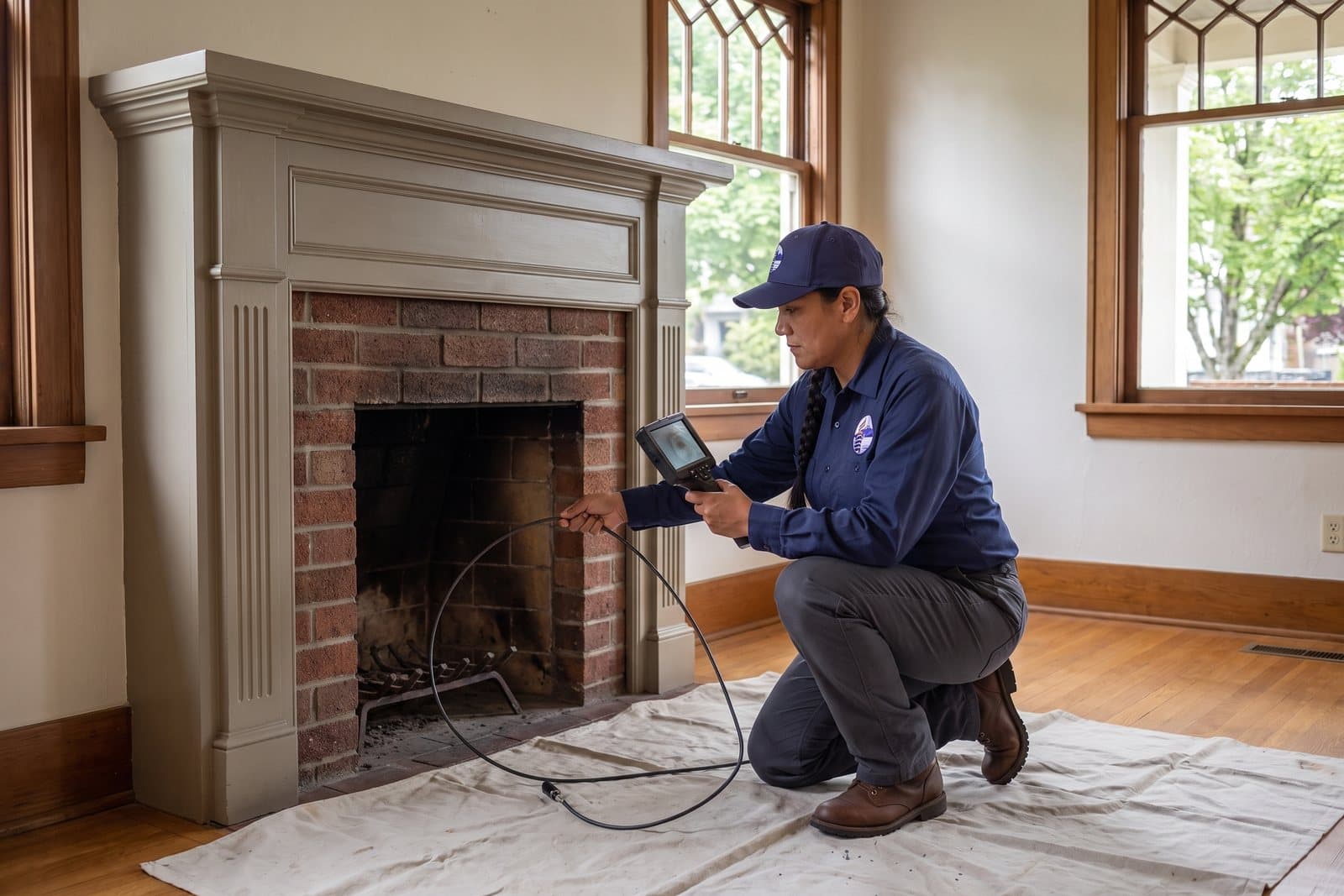
CSIA quotes the inspection rule of NFPA 211 on its homeowner page: chimneys, fireplaces and vents are inspected at least once a year for the three things listed here. For a masonry fireplace the institute would sweep once soot is 1/8 inch deep, and earlier if there is glaze. The State Fire Marshal gave the same inspect-and-clean advice on September 21, 2026, reporting six deaths from home heating fires in Washington the year before.
Soot comes off with a chimney sweep. Hardened glaze is a separate job, creosote removal. Fuel decides how fast either one returns: the Clean Air Agency allows seasoned dry wood or manufactured logs, and WAC 173-433-120 rules out garbage, plastic, rubber, treated wood, chemicals and paint.
Burn bans
Air quality burn bans for West Seattle are issued and enforced by the Puget Sound Clean Air Agency. They usually fall in the colder months, when stagnant air traps wood smoke. The fire marshal's summer fire-safety bans are a different measure.
The single exception is a home granted, in advance, the agency's exemption for having no other adequate source of heat. Adequate means able to keep 70°F at three feet above the floor; heat that is only costly does not qualify. Under WAC 173-433-150, a person with a fire already lit must stop adding fuel, and smoke still visible three hours after the episode is declared counts as evidence of a violation. The owner of the property receives the Notice of Violation.
On ordinary days the ceiling for smoke is 20 percent opacity, and six minutes above it in a row within one hour breaks the rule. The current status is on the agency's website.
Anything that burns makes carbon monoxide: wood, pellets, gas, oil. You cannot see it or smell it. The flue is its only way out of the house, and an alarm on every floor is the only way to know that the way out has failed.
How Seattle heats
Census estimates for 2020–2024 put electricity first in Seattle, the main heating fuel of 61.1 percent of occupied homes, then utility gas at 32.8 percent and fuel oil at 2.9 percent. Very few homes name wood as their main heat. Oil holds on longer here: in three of the ZIP code areas that cover the peninsula it still heats about 5 percent of homes. The table records the primary fuel only, so a fireplace lit on winter evenings appears nowhere in it.
Power cuts are when the risk peaks. In the December 2006 windstorm, 49 percent of Seattle City Light customers lost power and full restoration took a week; the city's hazard analysis records that several people in King County died heating their homes with charcoal. Charcoal and camp stoves stay outdoors. A fireplace or stove used for backup heat needs a flue that was checked before the storm, and a chimney cap that keeps nests and debris from blocking it.
Rain and wind
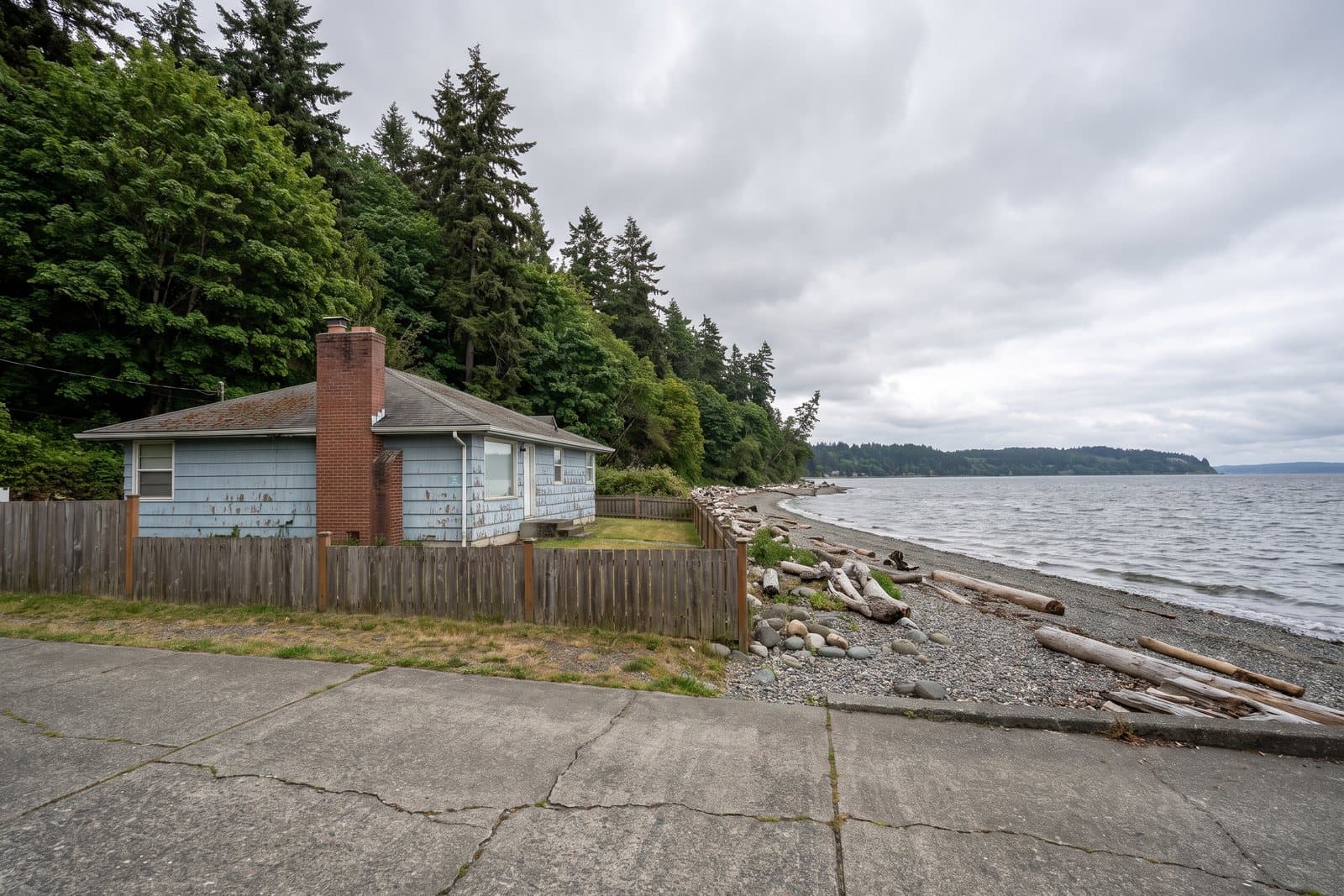
West Seattle has no weather record of its own; the nearest long-term station record averages 38.29 inches of precipitation a year, with 6.11 inches in November, 5.80 in December and 5.77 in January against 0.75 in July. WeatherSpark's Seattle profile dates the wetter season from October 10 to April 30 and the windier one from October 15 to April 24, with winds mostly out of the south.
The city's windstorm analysis says wind speeds up over hills and ridges and lists West Seattle among the most vulnerable parts of Seattle, since it is among the most heavily forested. On the water side, Seattle Parks replaced a 1920s seawall on Beach Drive in 2020–2021 after erosion and storm damage. Freezing is the lesser threat: the station record shows the low at or below 32°F on about 33 nights a year. Rain that gets in is handled by flashing repair at the roof line, masonry repair at the crown and joints, and waterproofing on brick that is still sound.
At the top
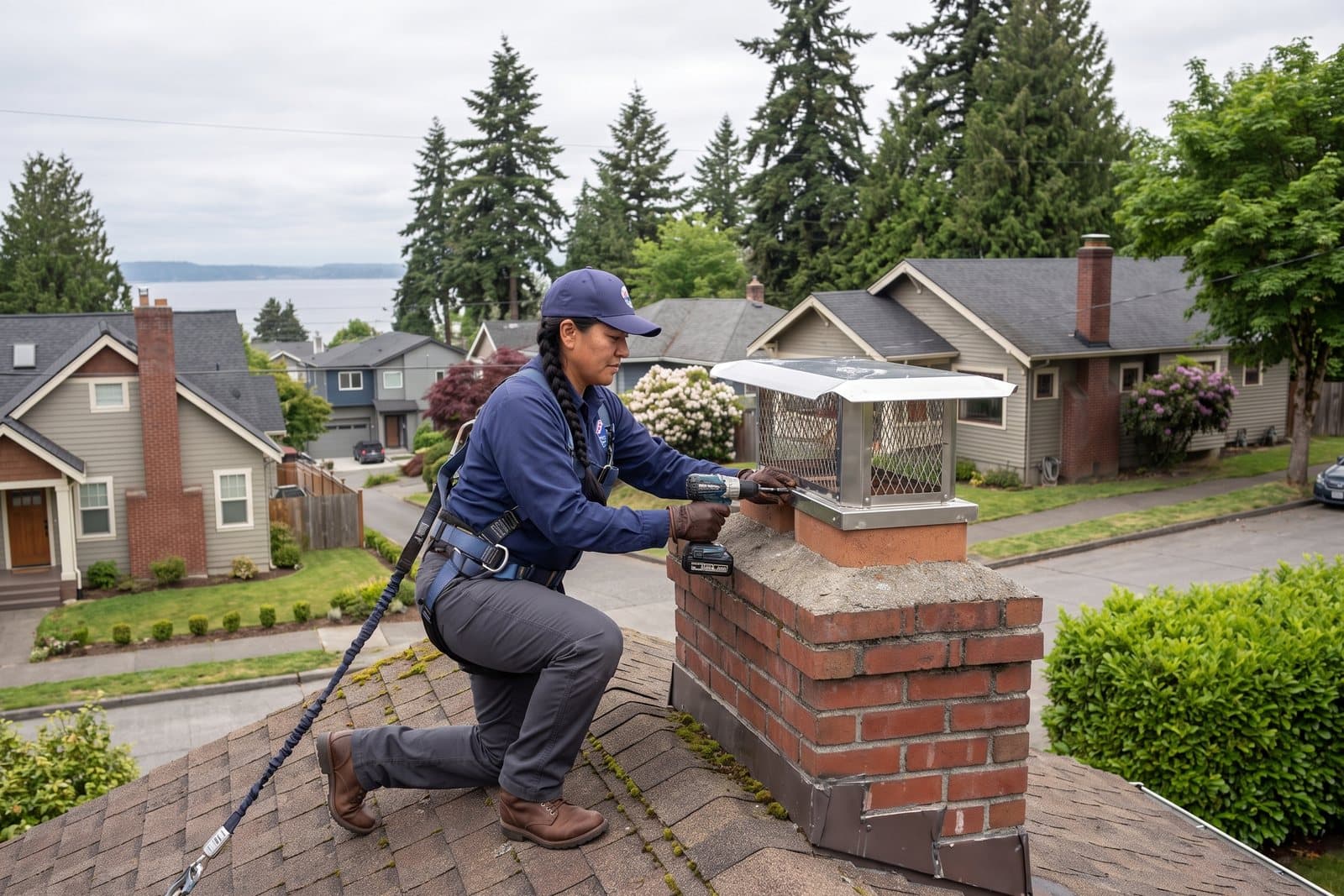
These are the terms of section R1003.9 of the 2021 Seattle Residential Code. A cap that has gone missing leaves the flue open to every storm of the wet season.
Moss is the other roof-level issue. Oregon State University Extension calls it unavoidable in the damp Northwest, explains that it traps debris and keeps roofing wet longer, and names trimming trees for sunlight as the lasting fix. One caution from the same page concerns chimneys directly: zinc sulfate moss treatments attack copper, so they should stay off a roof with copper flashing.
Around the firebox
The hearth extension of a masonry fireplace, under the Washington State Residential Code, projects 16 inches forward of the opening and 8 inches beyond either side. An opening of 6 square feet or larger raises those figures to 20 and 12. Anything combustible keeps a 4-inch gap from the back faces, and 2 inches from the front and the sides.
Washington's own amendment, WAC 51-51-1001, requires the damper to be ferrous metal and to sit at least 8 inches higher than the opening; it also requires a duct bringing air from outside, with a damper of its own. For solid-fuel appliances the Seattle code also asks for tight-fitting doors of metal or ceramic glass. A fireplace insert has to be listed to UL 1482 under the Seattle Mechanical Code, and installed as its manufacturer directs.
The dryer
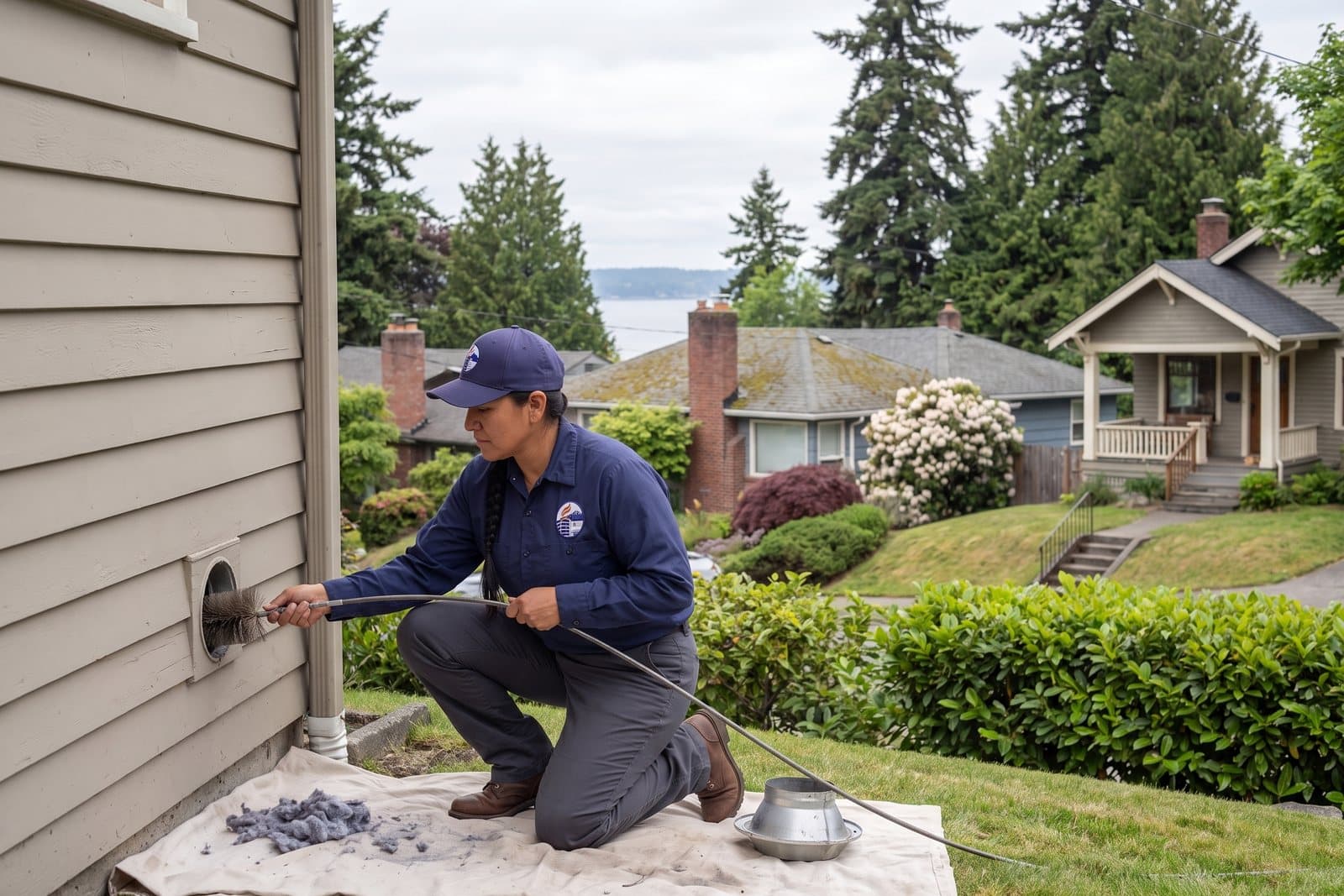
Section M1502 of the 2021 Washington State Residential Code describes the duct a dryer should have. Lint collects wherever that description is not met: a crushed transition hose, a run with too many turns, a screened outlet. Dryer vent cleaning empties the run and reports how it is built.
Summer
The Clean Air Agency's summary for 2024 reports no wildfire smoke in the region that year. Its health goal for fine particles was still exceeded on up to four winter days because of wood smoke, and on two July days because of fireworks. When a smoky summer does come, the agency recommends a HEPA filter or a box fan with a MERV-13 furnace filter, and one room kept as a clean room. A damper that closes fully keeps the flue from working against that effort.
Permits in Seattle
All ten of our neighborhoods are inside Seattle, so one office applies: the Seattle Department of Construction and Inspections. The Seattle Residential Code, at R105.2, exempts chimney repointing from a building permit when the building envelope is unchanged. It also exempts small repairs valued at $6,000 or less over six months that touch no loadbearing support, and like-for-like roof replacement without structural changes.
For a liner, a wood stove or an insert, no SDCI page read for this guide states a rule in so many words. The mechanical permit covers new heating and venting equipment, and gas piping needs a separate one. Before such a job we ask SDCI whether a permit is needed. A designated Seattle landmark needs a Certificate of Approval before any exterior change, even where no permit is required.
Division of labor
Most of chimney safety is habit. A smaller share needs a roof ladder, a flue camera or a gas manometer.
Before October 10
Seattle's wetter season opens around October 10. Repairs found in August can be finished before it does.
An eighth of an inch of soot means a sweep. Any glaze means it should not wait.
Check that the cap is in place, that nothing leans, and that no limb rests on the roof near the stack.
The Clean Air Agency posts the current stage there. Checking takes less time than laying the fire.
Further reading
Each post goes deeper on a single question raised here, with its sources listed at the end.
Questions
Sources
We opened every page in this list on October 4, 2026. Because NFPA 211 is sold rather than posted, its inspection rule appears here as CSIA reproduces it. The Booth study was read as its published abstract. Climate figures are for Seattle, not for the peninsula alone.
West Seattle Chimney Pros inspects the chimney, photographs what it finds and puts the findings in writing. That first visit is $99 plus tax, and the fee comes off the bill once you approve the quote for the work.