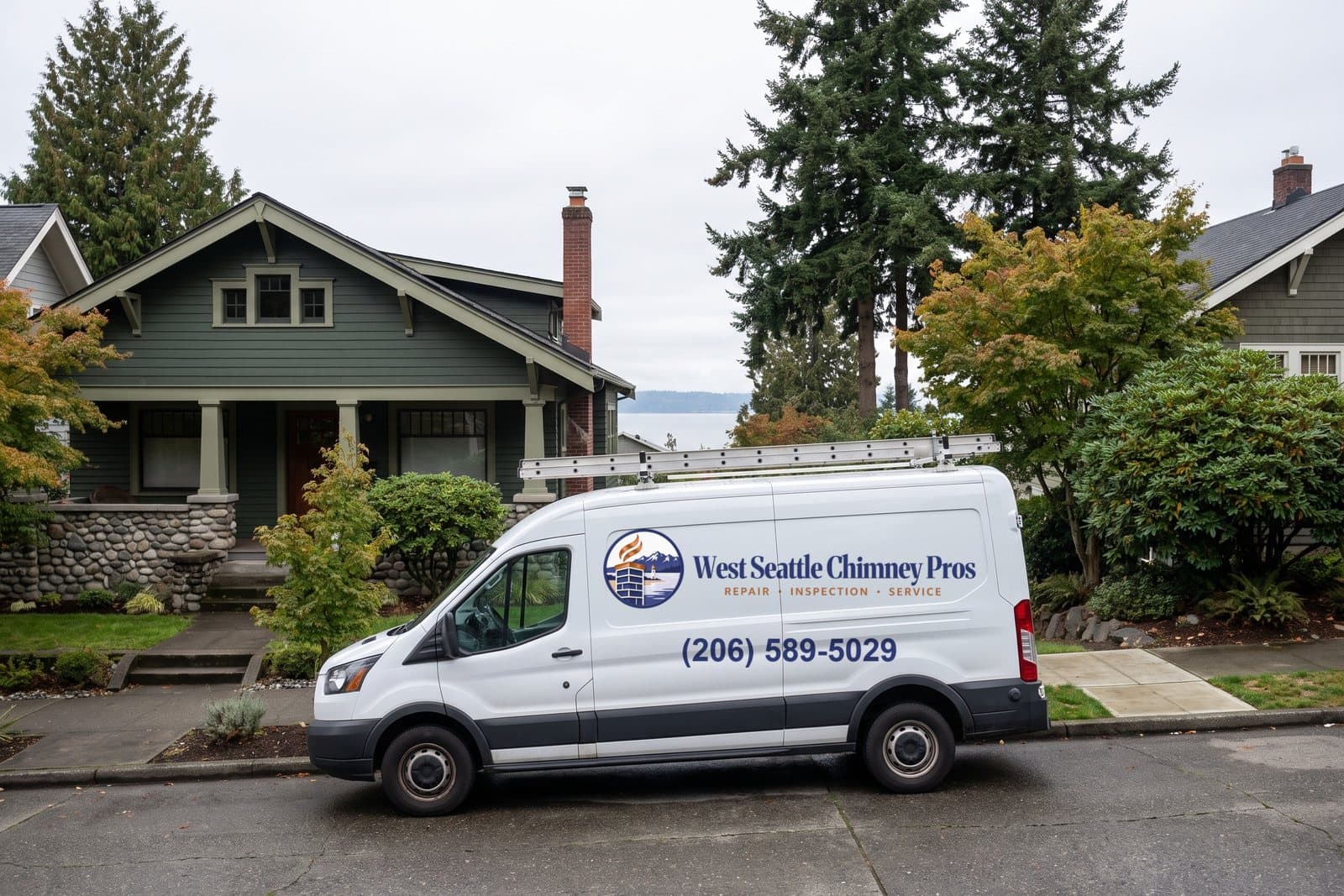
Fauntleroy, King County
Fauntleroy is the corner of Seattle where the ferry leaves for Vashon, and most people know it from the car line. Behind the dock is a neighborhood more than a century old, tucked between a cove, a wooded park and a steep slope. Those three things, along with the age of the houses, decide what a chimney here has to put up with. This page sets out what public sources say about each, with the source named, so that when we describe your chimney's situation you can check our reasoning against something other than our word.
Book an inspection
Book your $99 inspection
$99 plus tax, deducted when you approve the repair
Not sure where to start
Pick what you're seeing at your Fauntleroy home — we'll point you to the right fix.
What we do
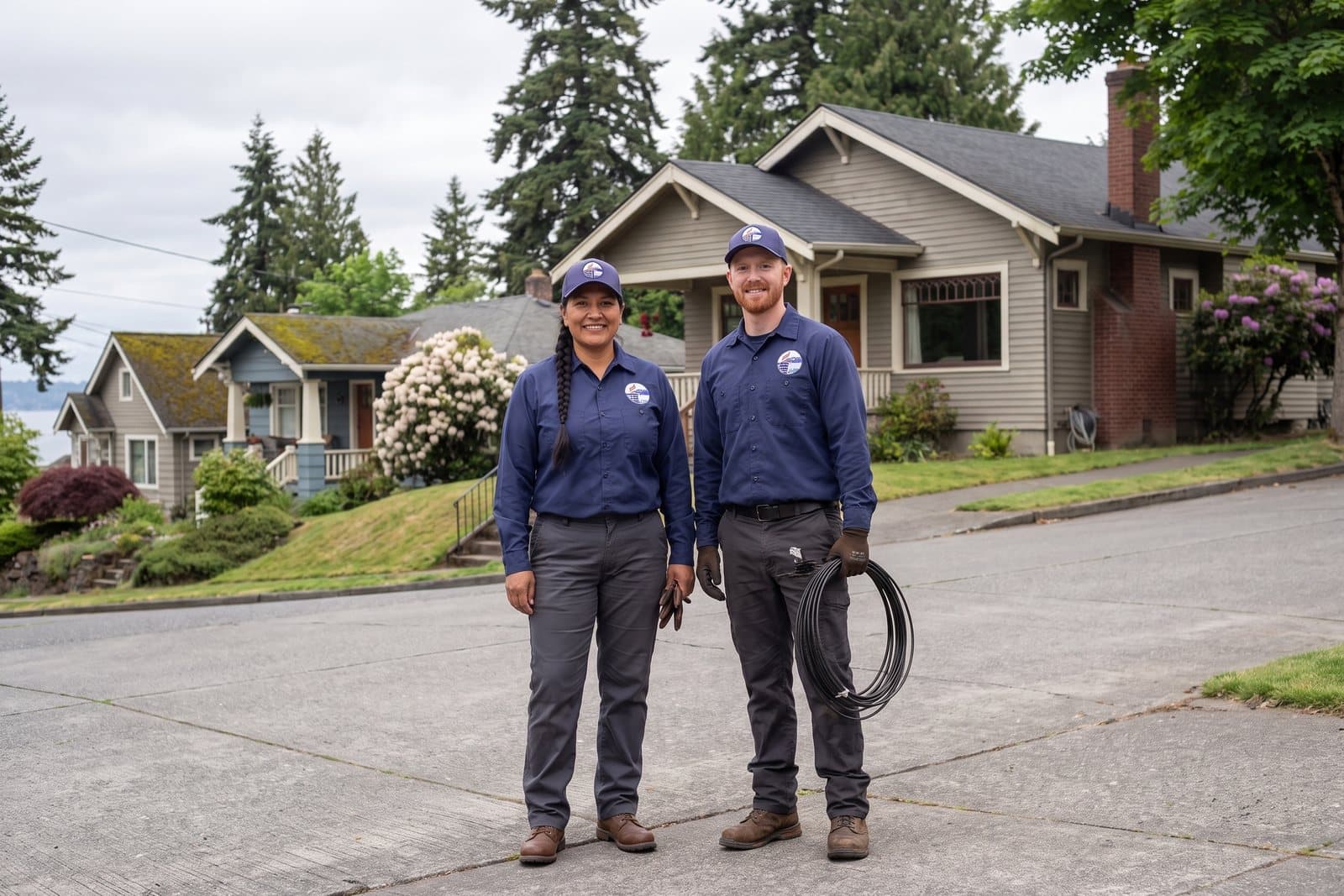
The same crew, the same written quote — for Fauntleroy homes.
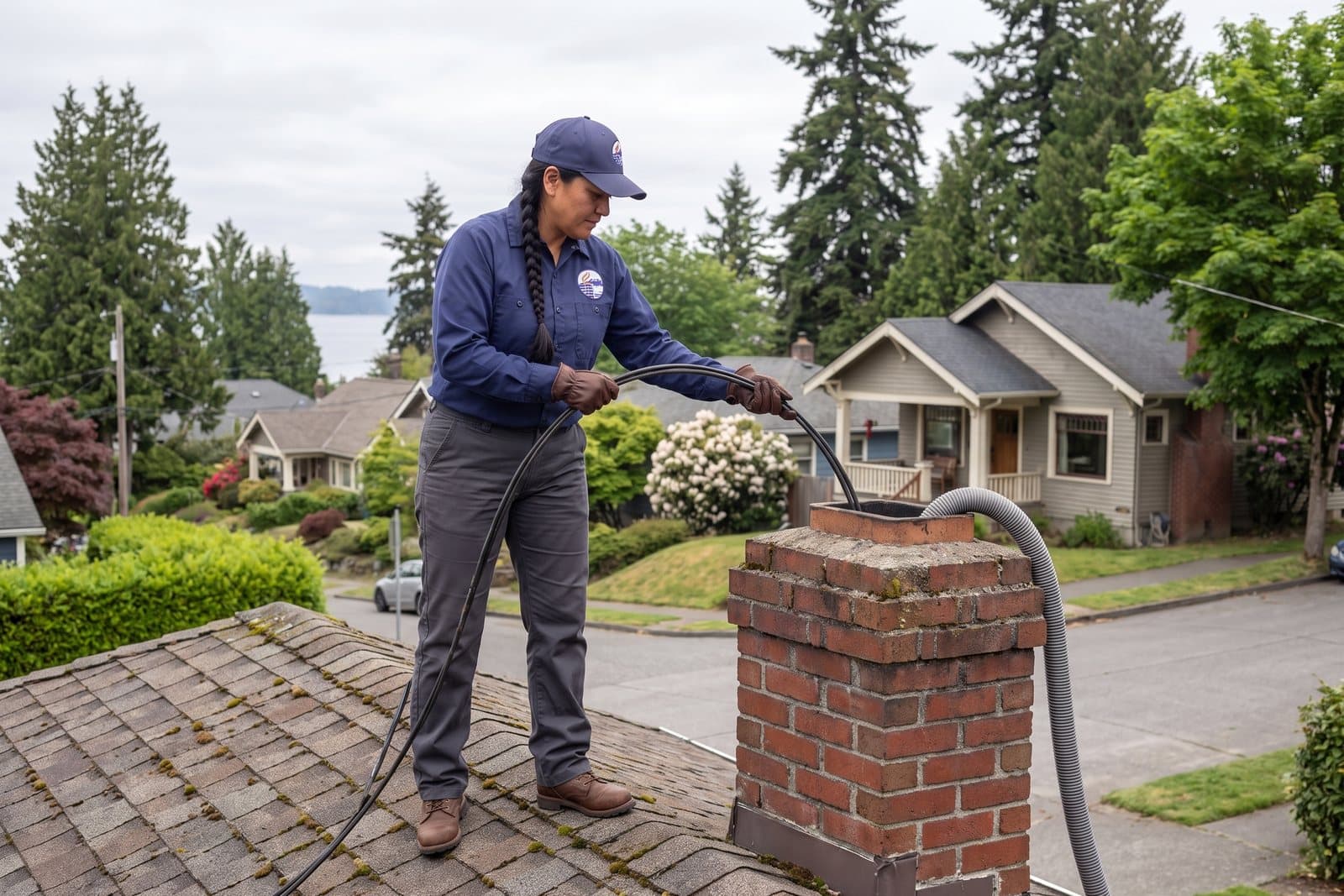
Full-height brushing of the flue with a head sized to its shape and material
Learn more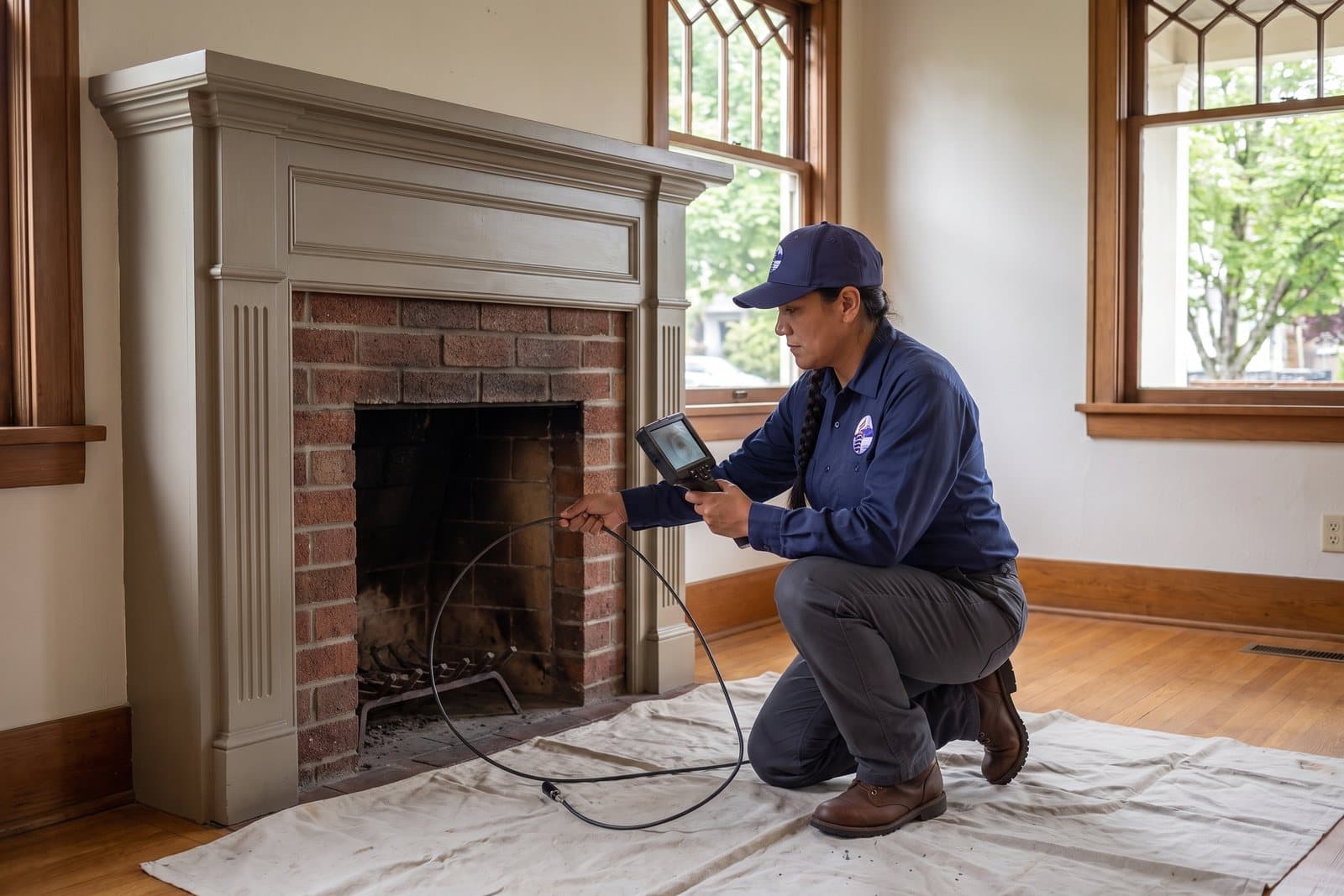
Level 1 examination of everything reachable, with a Level 2 camera pass when the reachable parts leave a question open
Learn more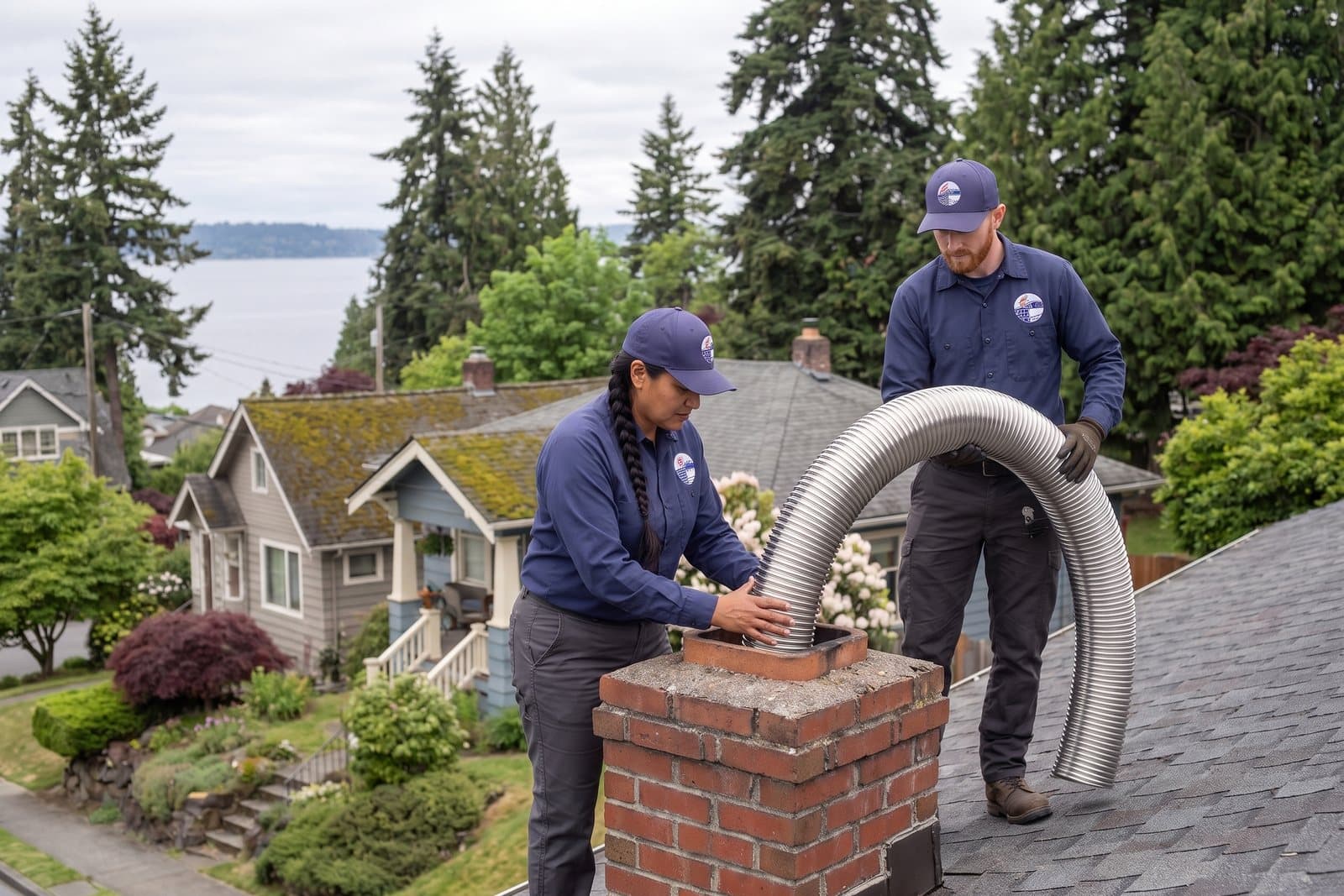
Camera survey and measurement of the existing flue before anything is ordered
Learn more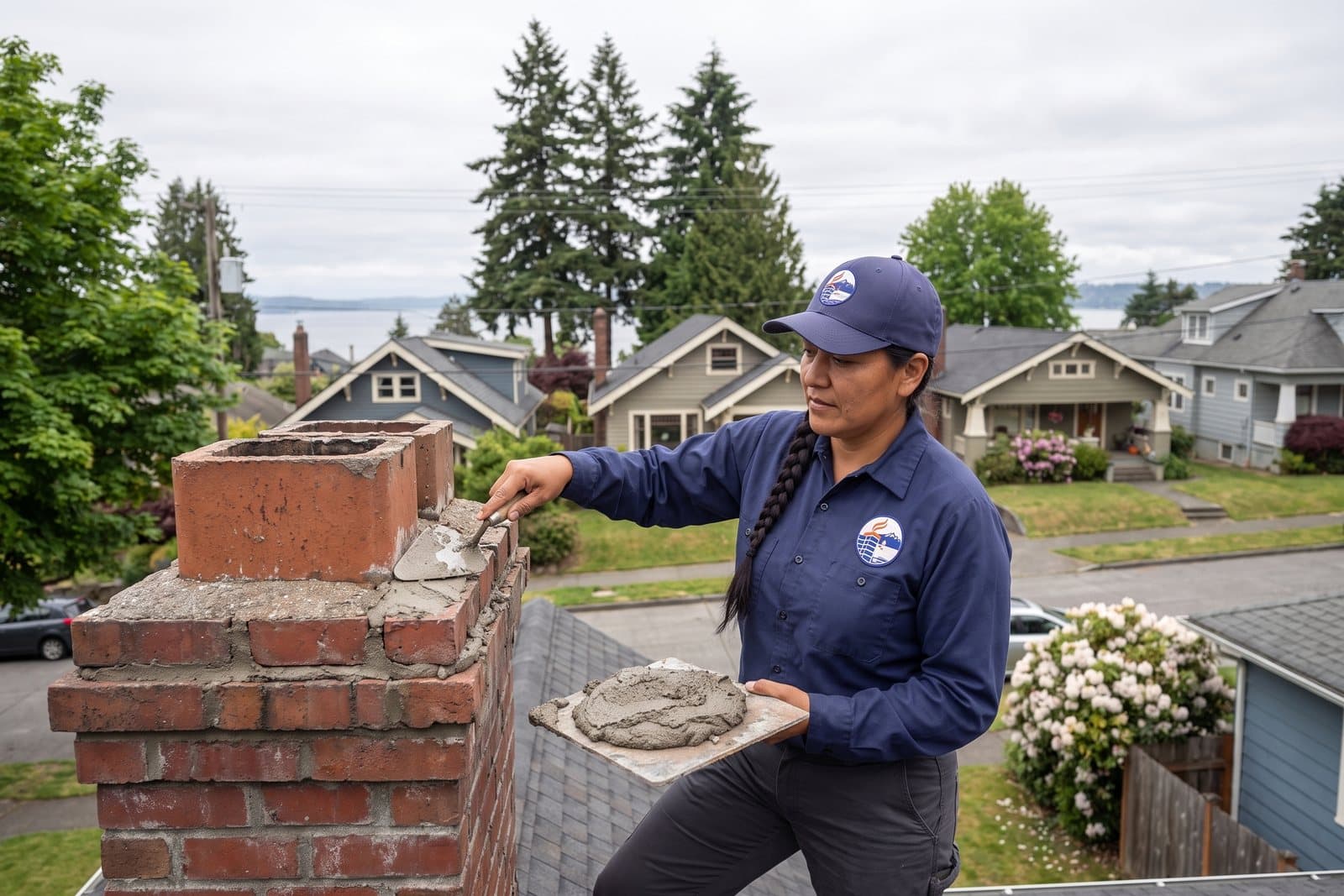
Assessment of the stack from roofline to crown, with a photo of each defect
Learn more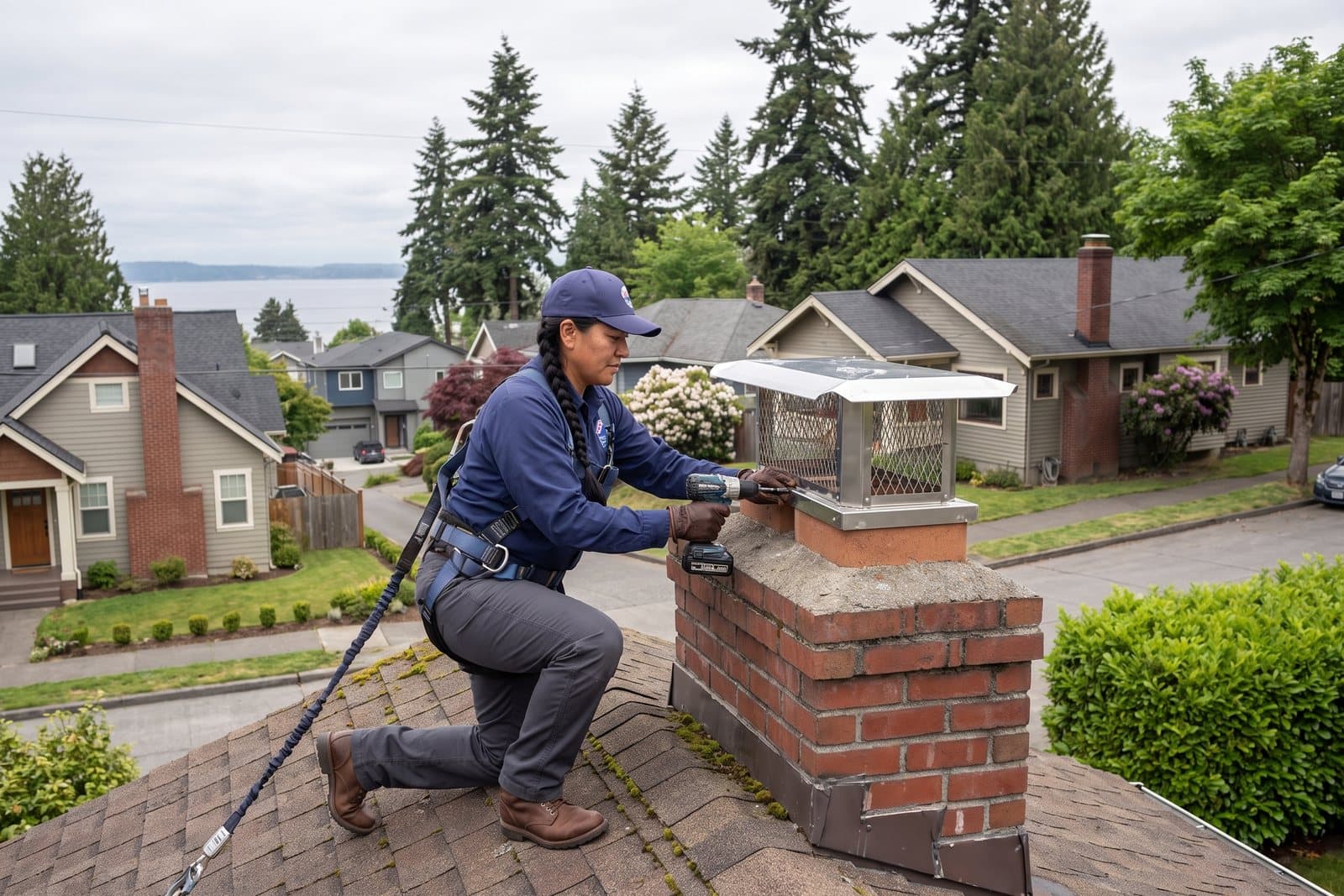
Measurement of each flue tile, or of the whole crown for a multi-flue cap
Learn more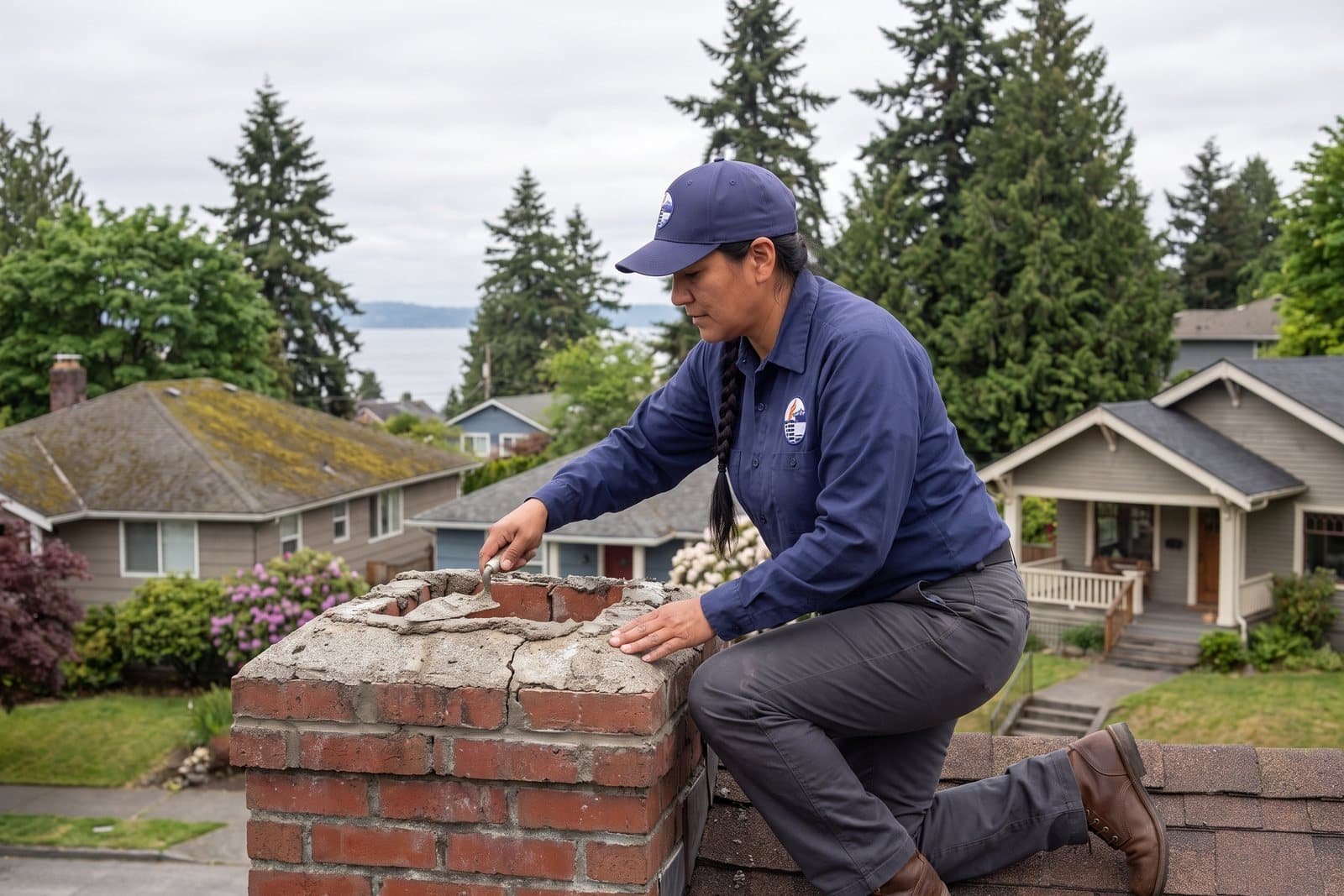
Joints cut back to firm mortar and repointed (tuckpointing) to match the existing profile
Learn more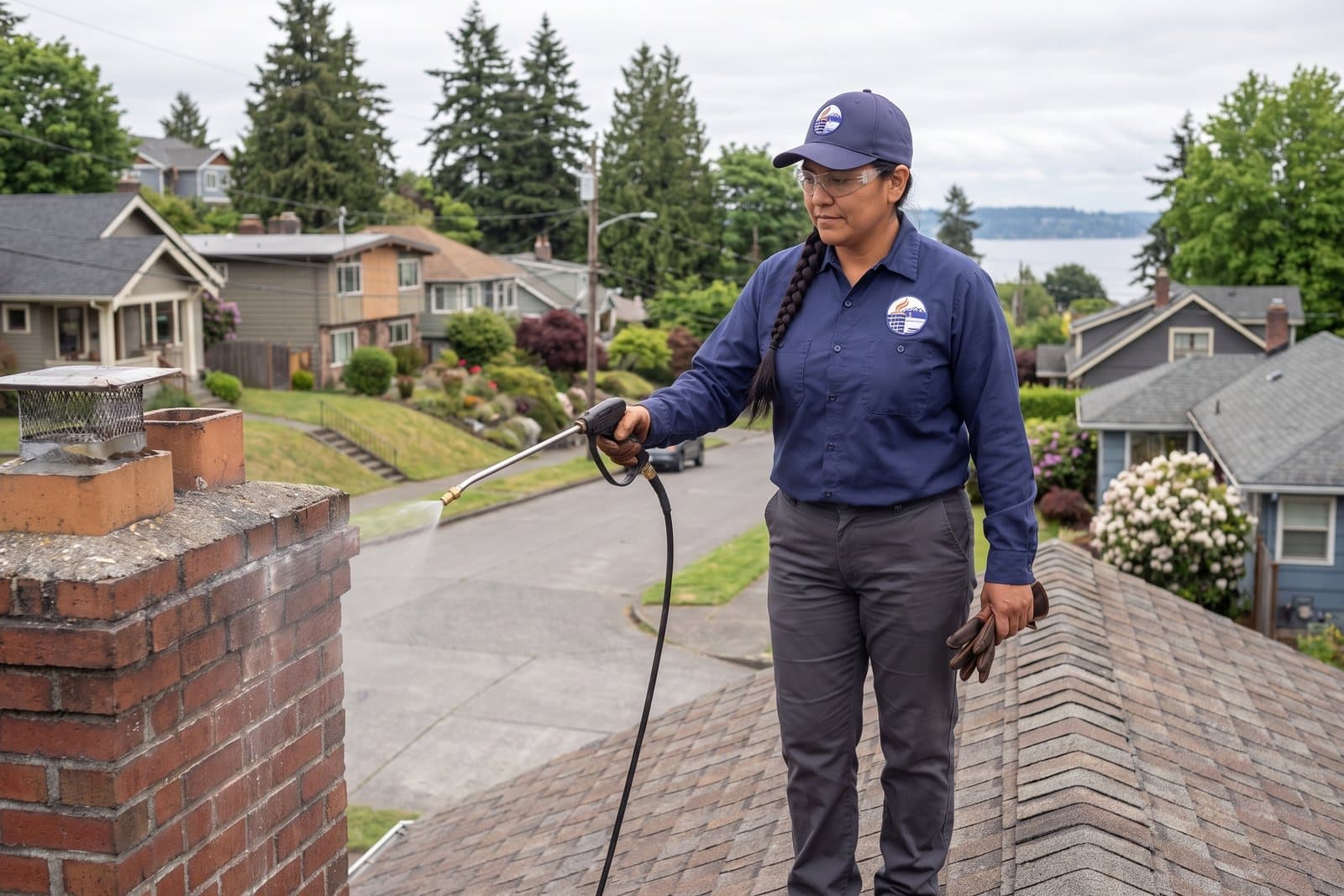
A check of joints, crown and flashing first; defects are repaired before any treatment
Learn more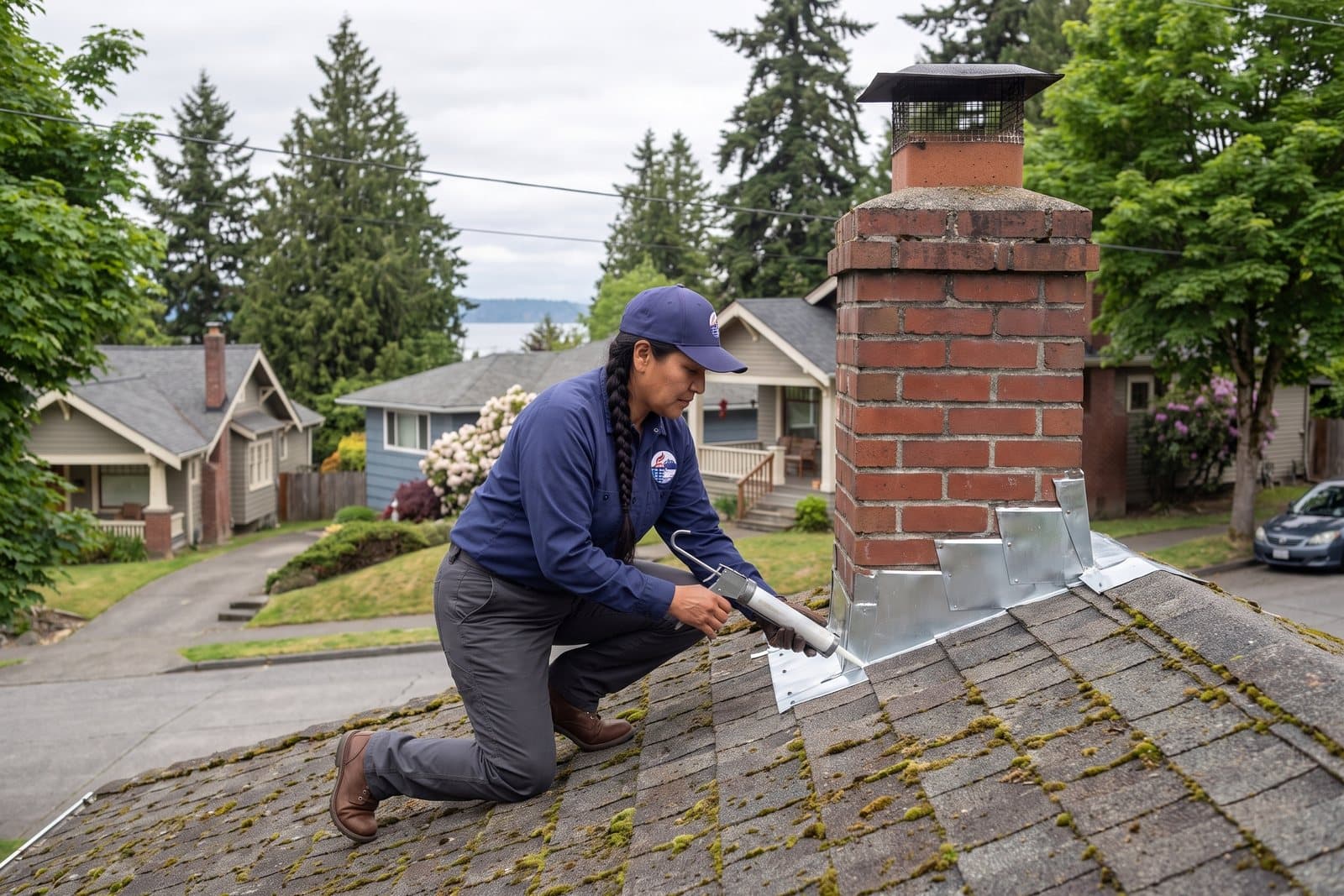
Leak tracing from the attic or the ceiling stain up to the roof
Learn more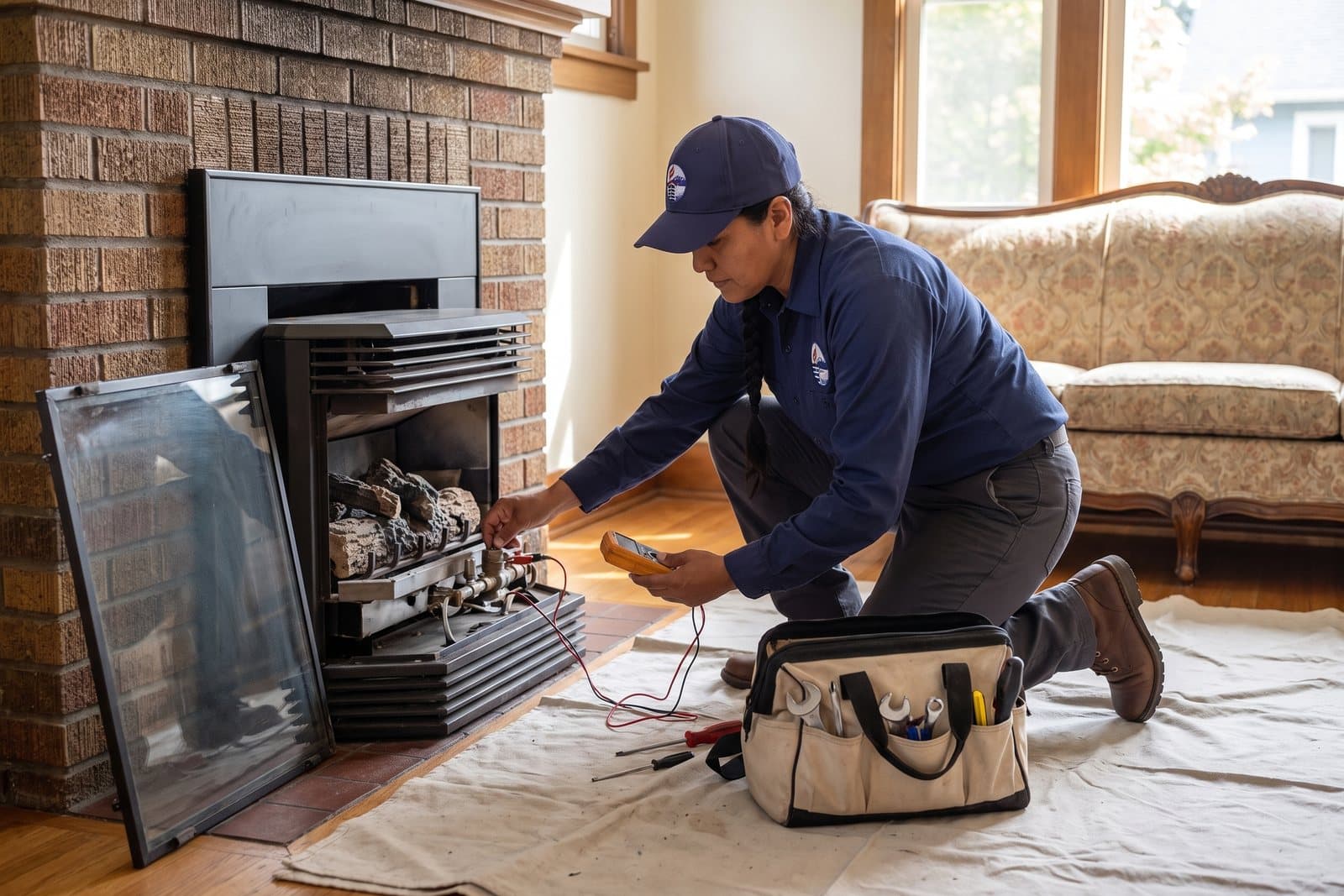
Burner, pilot assembly and firebox cleaned; logs or media put back in the layout the manual shows
Learn more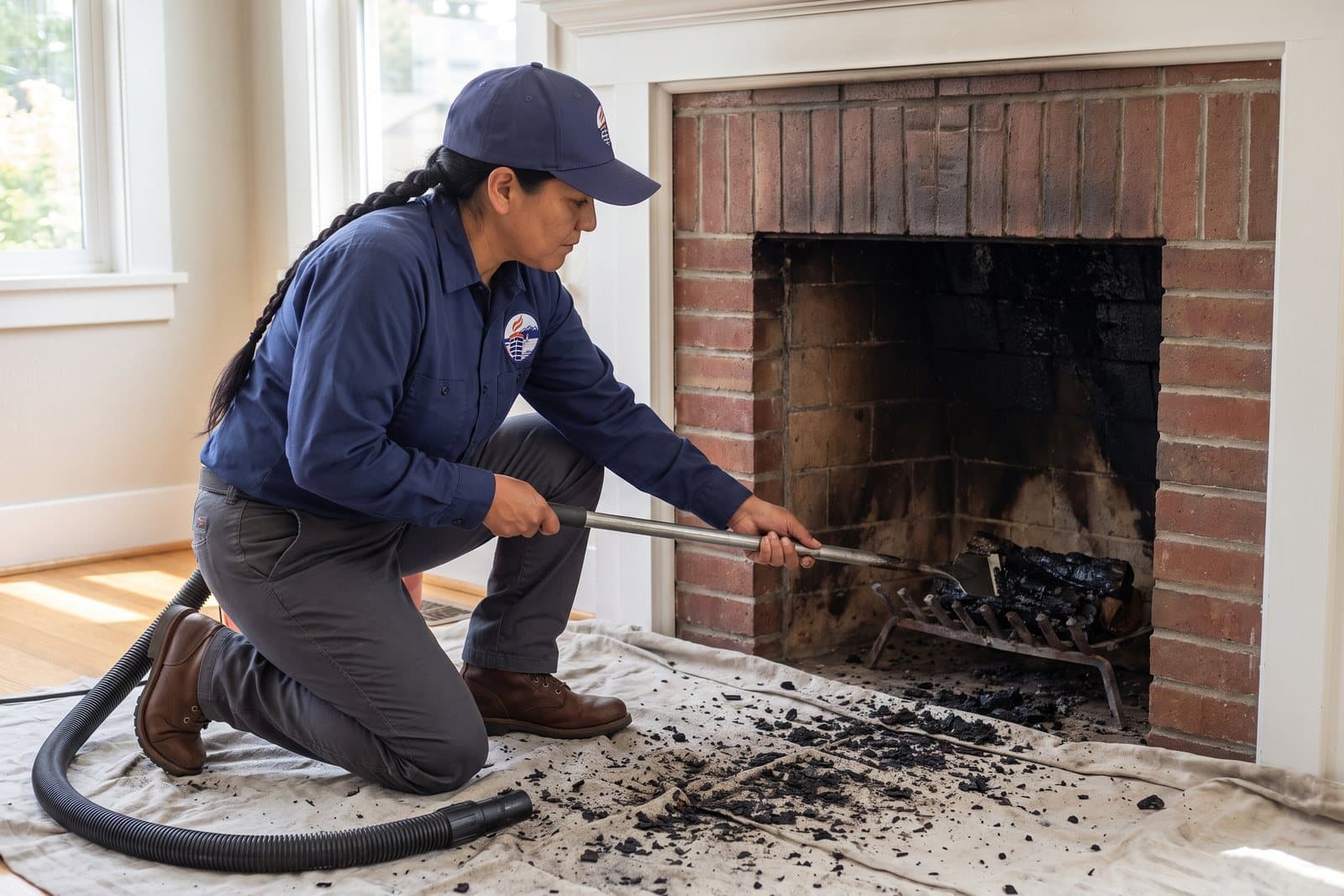
Camera survey to grade the deposit and check the liner beneath it
Learn more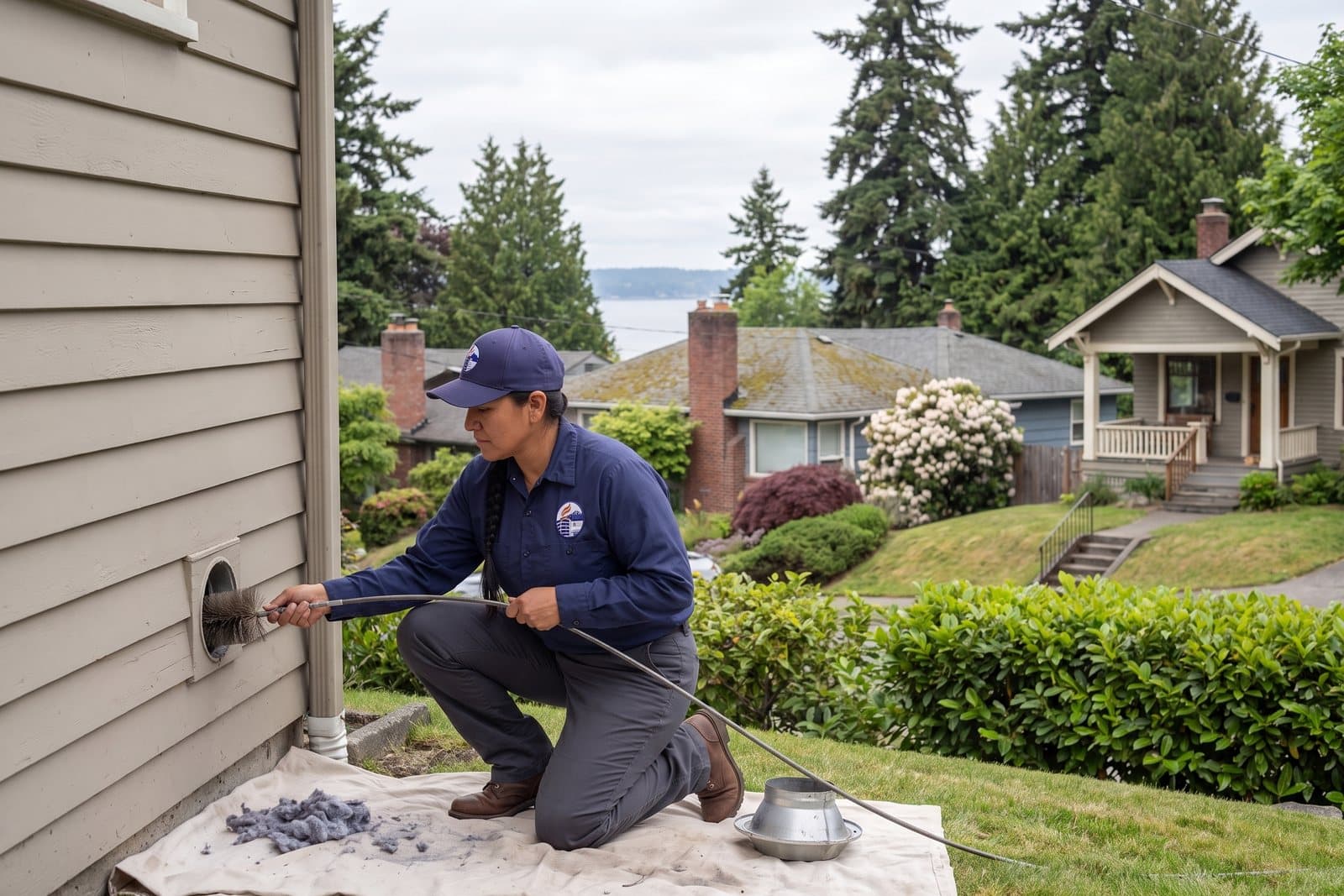
Dryer pulled out; the transition duct inspected, and replaced if it is plastic, thin foil or crushed
Learn more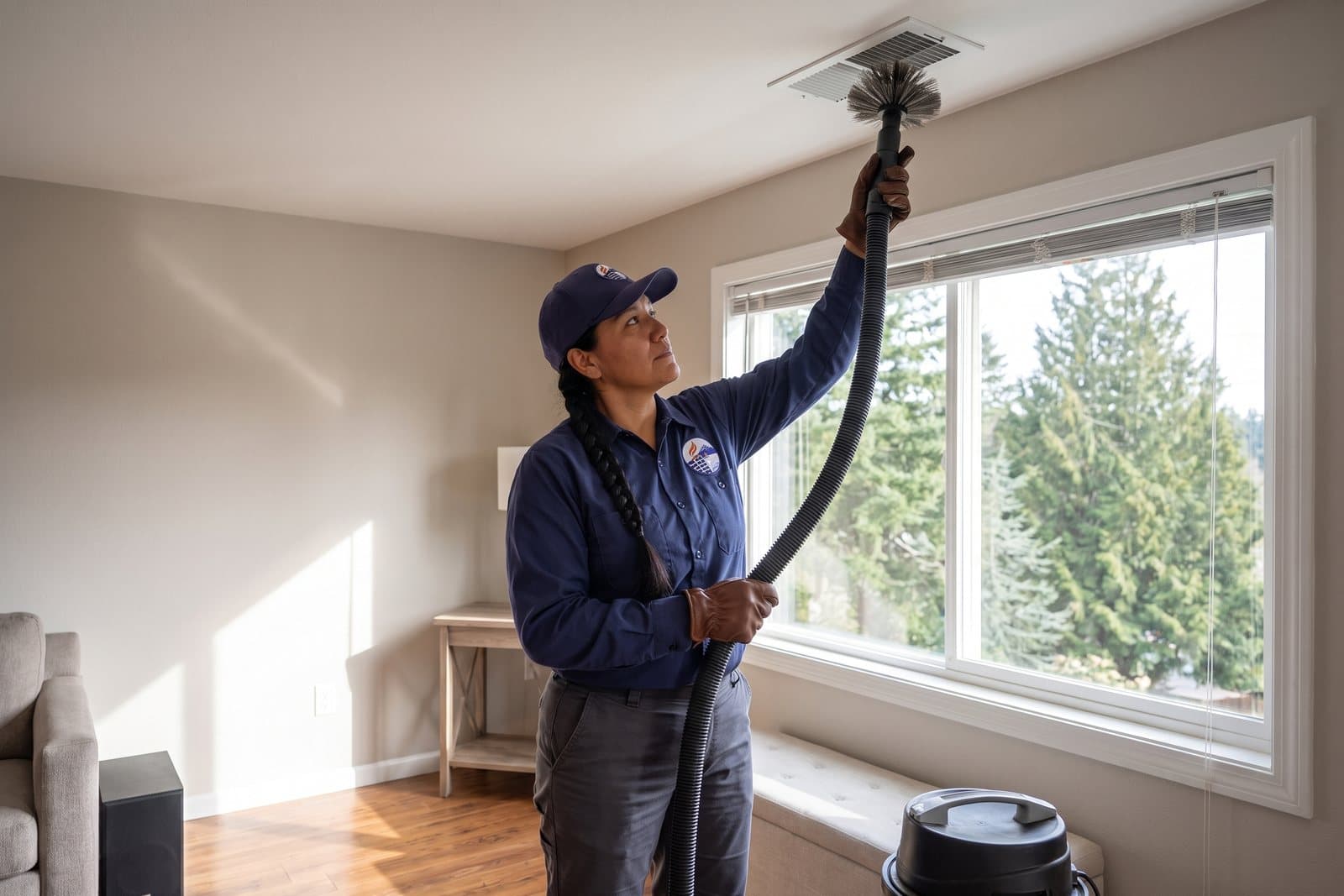
Inspection of the furnace, the plenum and a sample of ducts before any work, with photos
Learn moreRanges shown for orientation — the exact figure is written up on-site, after the inspection.
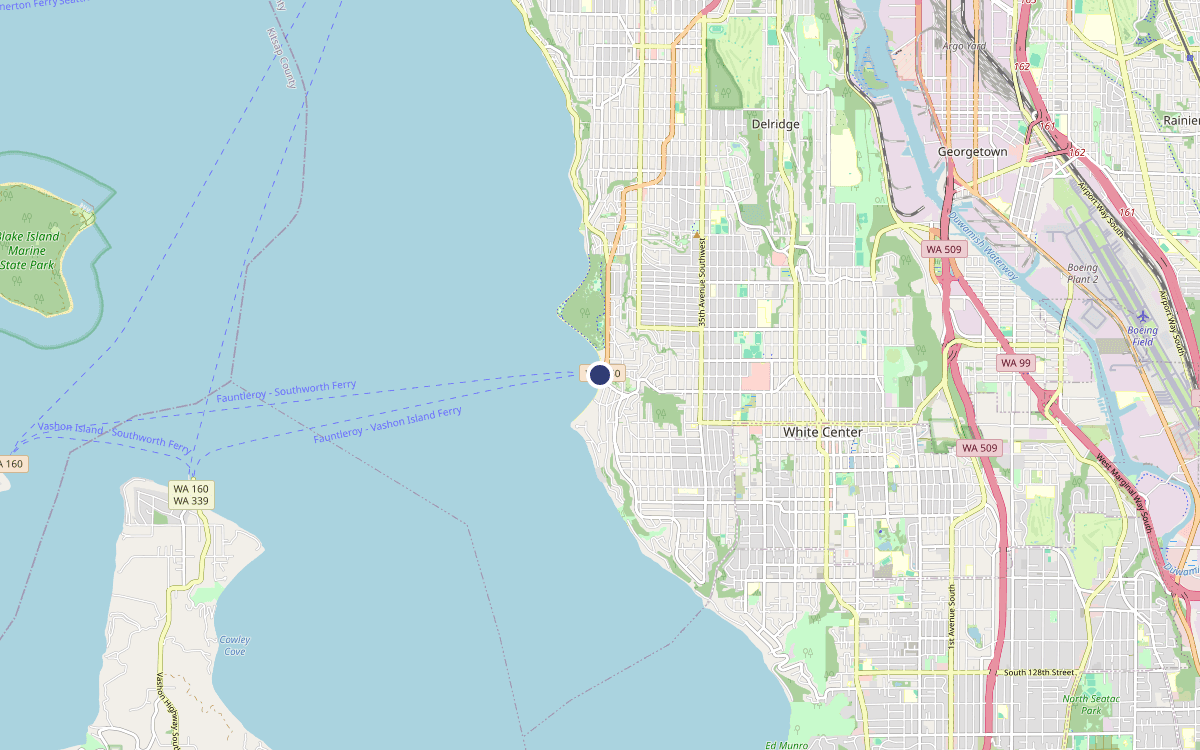
Service-area map — Fauntleroy, Seattle. Map data © OpenStreetMap contributors.
Wikipedia locates Fauntleroy in the southwest corner of Seattle, on Fauntleroy Cove, with Lincoln Park to its north, Fauntlee Hills to its east and Arbor Heights to its south; the Olympic Mountains lie some 40 miles off to the west. Lt. George Davidson named the cove in 1857 for the family of his fiancee, Ellinor Fauntleroy, as HistoryLink tells it. No census is taken at neighborhood scale, so the housing figures used below belong to a Census ZIP code area that also reaches into Gatewood and the southern Seaview waterfront: 8,345 housing units, of which 65.1 percent are detached single-family houses.
The settlement began as a retreat. In 1905 John Adams bought 300 acres here and sold 17 of them, along the cove, to James Colman, who talked friends from his congregation into building summer cabins. Seattle Parks gives 1904 for the start of the summer colony, a year earlier than HistoryLink's land purchase; we report both dates and do not choose between them.
Isolation ended on February 15, 1907, when streetcars began running on the Fauntleroy Park line, the same year West Seattle was annexed to Seattle. The Kenney Presbyterian Home opened that year as well. On July 25, 1908 the congregation put up Fauntleroy Church in a single day on land Adams donated. Year-round houses took the place of the tents and cabins, in the Southwest Seattle Historical Society's words, soon after.
A brick school opened in February 1918 to replace a schoolhouse lost to fire in 1911. By the 1920s a regular ferry crossed the Sound from the dock, run then by the Kitsap County Transportation Company and now by Washington State Ferries. Where the streetcar turned around, above the dock, a small business corner took the name Endolyne; the city's commercial survey dates its present retail building to 1926.
The second wave came after 1945. HistoryLink and the historical society agree that homebuilding had spread to the hillsides above the cove by the 1950s. The school shows it: additions in 1950 and 1953, a peak of 700 pupils in 1954-55. It closed in June 1981. In 1972 the city bought 28 acres from the Fenton family to make Fauntleroy Park, which protects the headwaters of the creek.
That ZIP code area holds the oldest housing on the peninsula: 30.1 percent of its units predate 1940, the top figure among the peninsula's ZIP areas, and another 20.4 percent date from 1940 through 1959. The median unit dates from 1960. Those are area-wide figures and Fauntleroy's own share is not published.
They are still useful. A flue from the cabin-and-streetcar years and a flue from the postwar hillside were built to different habits, and neither was built to today's code. No source tells us which Fauntleroy houses have brick chimneys, metal ones or none, so we never assume it from an address. We do assume, until the camera says otherwise, that a chimney of either generation has had repairs nobody wrote down.
That Census survey also records what fuel mainly warms each lived-in home. Around Fauntleroy the answers are electricity for about half, utility gas for 41.9 percent and fuel oil for 4.7 percent, the last well above Seattle's citywide 2.9 percent. Only a handful of households name wood as their main heat, and the survey's own uncertainty on that number exceeds the number itself. The survey does not count fireplaces, which in practice are far more numerous than wood-heated homes.
Fauntleroy's waterfront has been armored for ninety years. Federal relief crews of the 1930s (WPA, CWA and CCC) cleared Lincoln Park and built its trails and seawalls, the Southwest Seattle Historical Society records, and Seattle Parks today counts about a mile of seawall and rocky beach below the park's bluff. The Colman family added the saltwater pool at Point Williams in 1941.
Uphill, the ground is less settled. The Seattle Landslide Study logs 21 landslides since 1955 in its 47th Avenue SW area, a steep slope facing west-southwest around Maplewood Place SW, and notes that the city built retaining structures and drainage there after the storms of 1996-97. For land south of Lincoln Park that Seattle annexed only in the 1950s, the study cautions that older instability is simply missing from city files. It also explains the mechanism common to West Seattle's hills: sand lying over clay, with springs emerging where the two meet.
For chimney work this translates into three habits. We treat the water-facing side of a stack as the worn side until shown otherwise. We check plumb, because a chimney is rigid and reveals ground movement early. And we plan access before quoting, since the low side of a hillside house may put the flue top a full story higher than it looks from the street.
West Seattle has puzzled seismologists since 1965, because its chimneys fall in earthquakes that leave nearer districts alone. The USGS Earthquake Hazards Program publishes a simulation that offers an explanation: some 300 meters underground, a buckle in the bedrock about 200 meters wide gathers seismic waves coming up from the south and focuses them. The zone of amplification in the model broadly matches where chimney damage was reported in 1965 and again in 2001.
The Seattle Landslide Study supplies the setting. It places the peninsula south of the Seattle Fault, a reverse fault running east-west, which is why bedrock sits closer to the surface here than north of it. And the city's 2017 report on unreinforced masonry observes that Seattle is the only American city whose brick buildings were damaged by three separate earthquakes inside 73 years.
No source here maps the effect down to individual blocks, so we make no claim about whether Fauntleroy lies in the zone. The practical conclusion is modest: an older brick chimney anywhere on this peninsula deserves a look after any earthquake strong enough to be felt, including at the levels you cannot see from the ground.
Wood smoke in Fauntleroy answers to a regional regulator covering four counties, the Puget Sound Clean Air Agency; it calls the air quality bans and polices them itself. Most of its bans fall between autumn and late winter, in cold, windless spells that leave smoke hanging low. The fire marshal handles the separate summer bans aimed at fire danger.
There are two stages. Under Stage 1, wood fireplaces must stay dark, and so must any wood stove or insert without certification. Stage 2 adds the certified ones and pellet stoves. Exemptions exist only for homes the agency has cleared ahead of time as lacking adequate heat, and the bar is high: if the house can be kept at 70 degrees at a height of three feet, it has adequate heat. High running costs do not count.
Two rules apply every day of the year. Any day of the year, a plume from your chimney has to stay below 20 percent opacity, judged over a six-minute window each hour. While a ban is on, the standard drops to nothing visible, and that applies to exempt households too. Clean, dry-burning fires and a flue in good order are how a household stays inside the first rule; the agency's ban status page is how it learns about the second.
The grid we quote from for Fauntleroy homes — the $99 inspection comes first, the written quote before any work.
| Service | Price in Fauntleroy | What that covers |
|---|---|---|
| Chimney Sweep | $189–$449 | Full flue swept, Level 1 inspection included |
| Chimney Inspection | $99 plus tax | Level 1 visual; Level 2 adds a full camera scan |
| Chimney Relining | From $1,900 | Full-length stainless liner, sized to the appliance |
| Chimney Repair | From $425 | Masonry repair — brick and mortar, scoped after diagnosis |
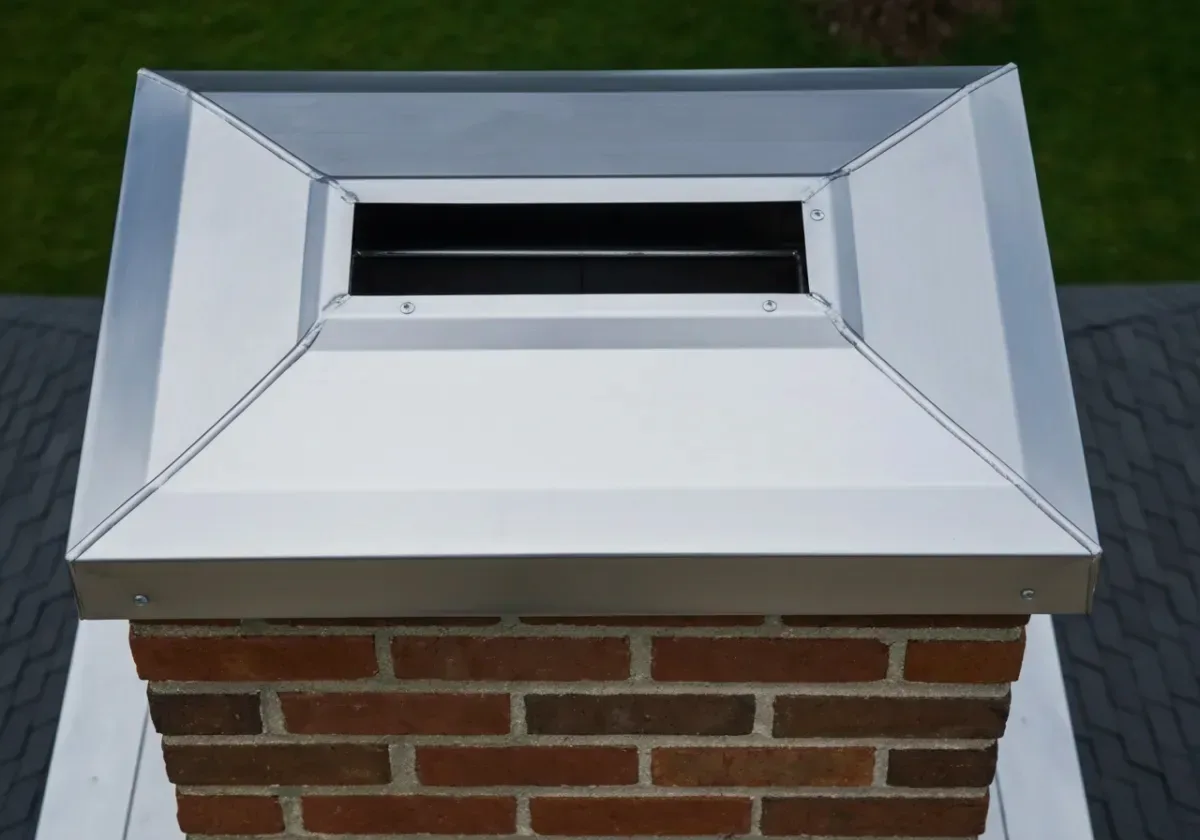
| Chimney Cap Installation | $235–$850 | Stainless cap fitted; multi-flue and custom at the top |
| Masonry Repair (Crown / Repointing) | From $475 | Crown work, repointing and tuckpointing by surface area |
| Chimney Waterproofing | $320–$795 | Breathable sealer — reapplied every 3–5 years in this climate |
| Chimney Flashing Repair | $375–$1,500 | Reseal at the low end, full flashing replacement at the high |
| Gas Fireplace Service | $189–$475 | Annual service and tune-up; repairs quoted after diagnosis |
| Creosote Removal | From $245 | Priced by creosote stage — glazed stage 3 is the heavy end |
| Dryer Vent Cleaning | $105–$295 | Full run cleaned; roof or upper-floor terminations at the top |
| Air Duct Cleaning | From $535 | Whole HVAC system — trunks, branches and every register |
Ranges are what these jobs are quoted at in Fauntleroy. The exact figure is set on site after a $99 inspection (credited toward the job if you go ahead), and you approve it before any work starts.
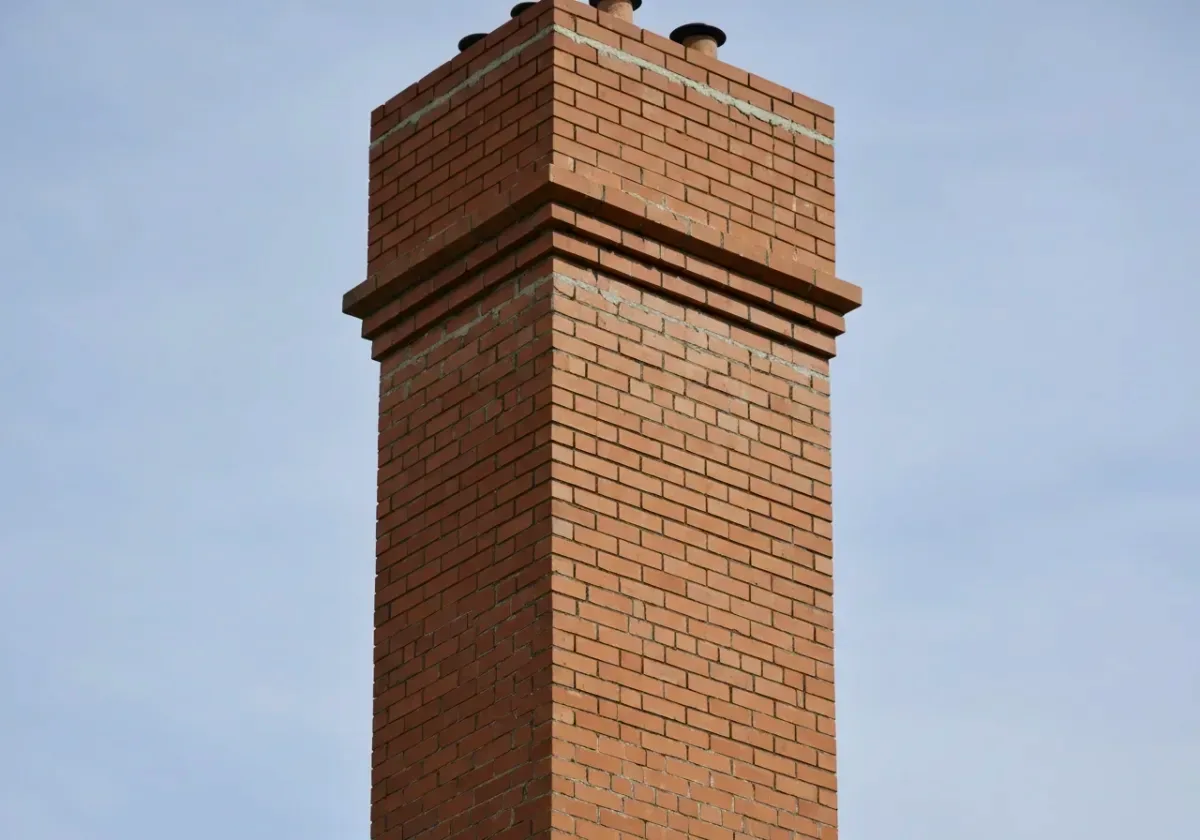
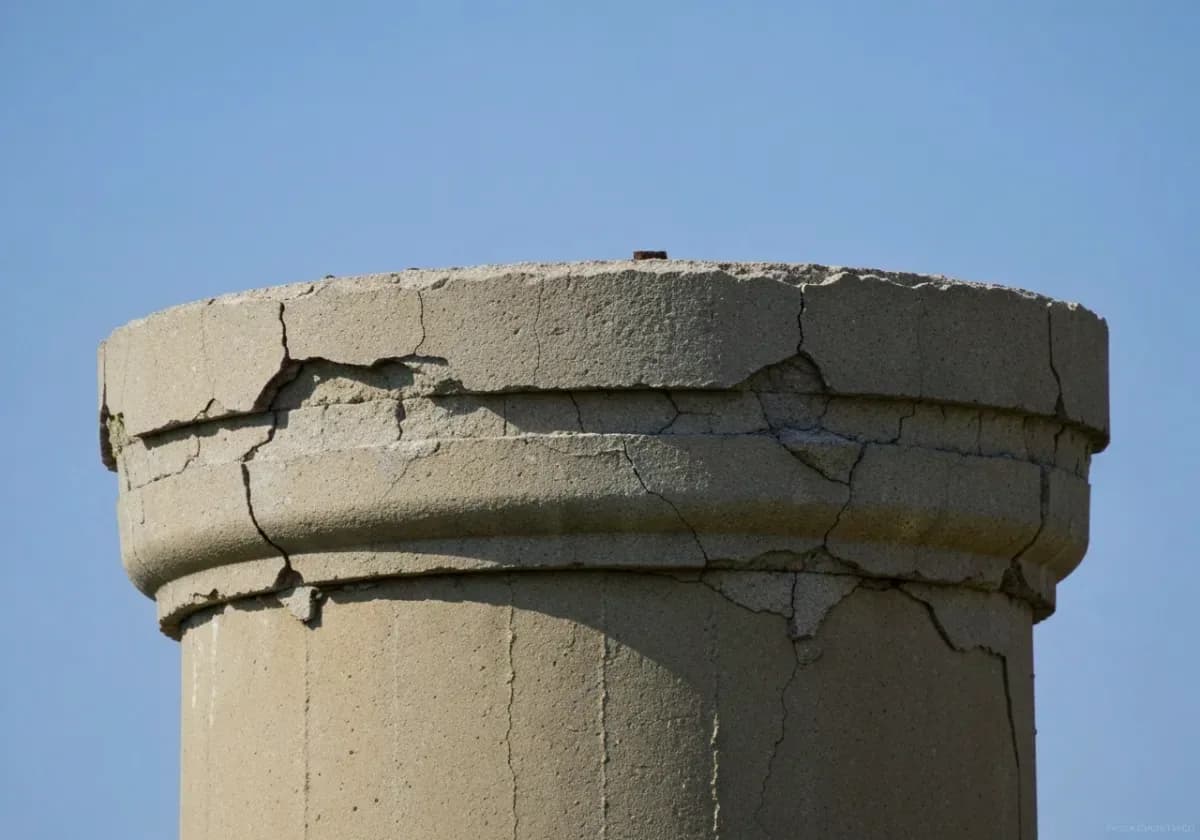
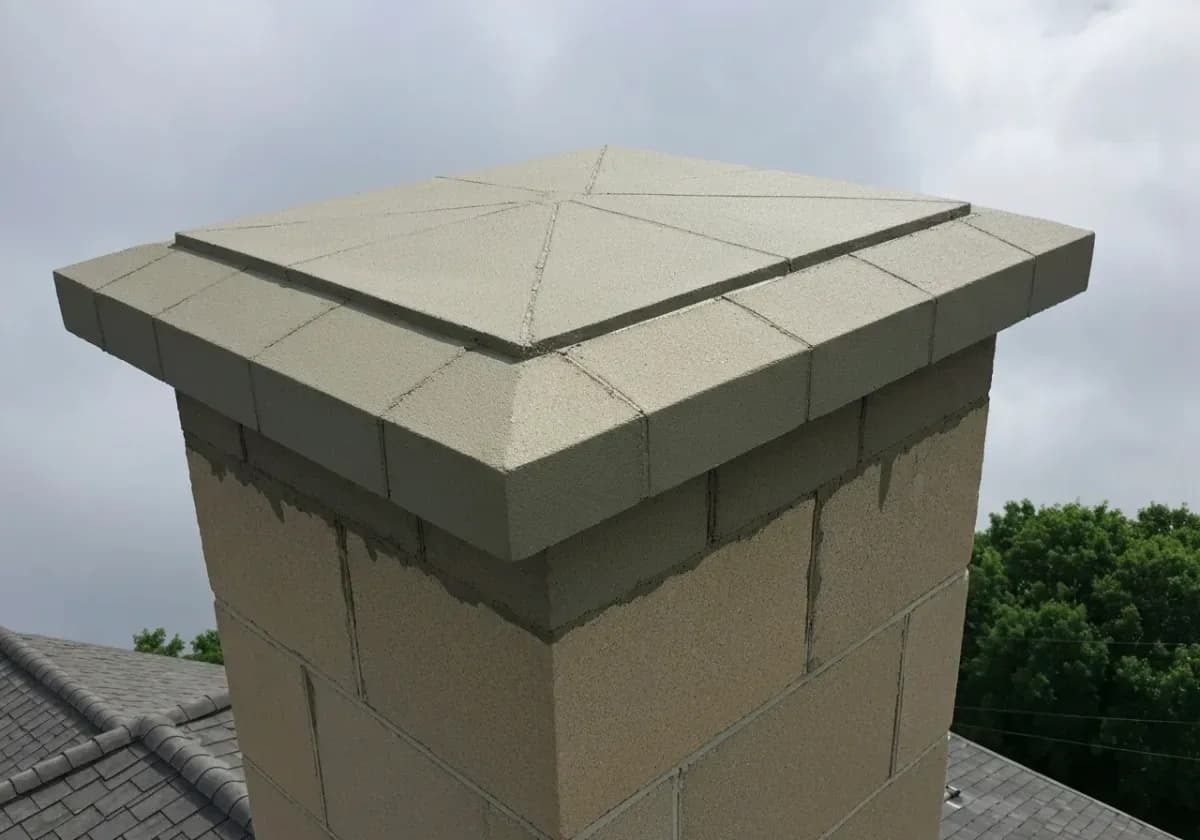
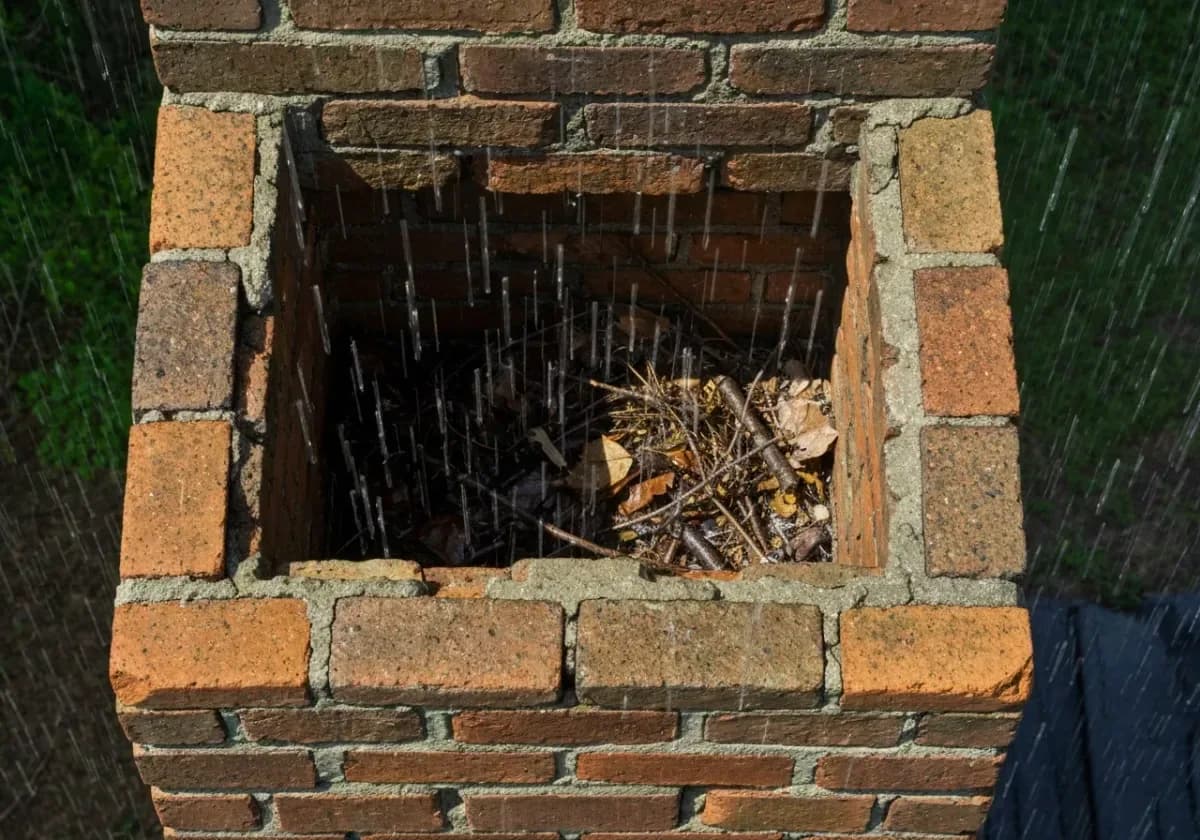
Before and after
Illustrations of what each repair changes on a typical chimney — not photos of a specific job.
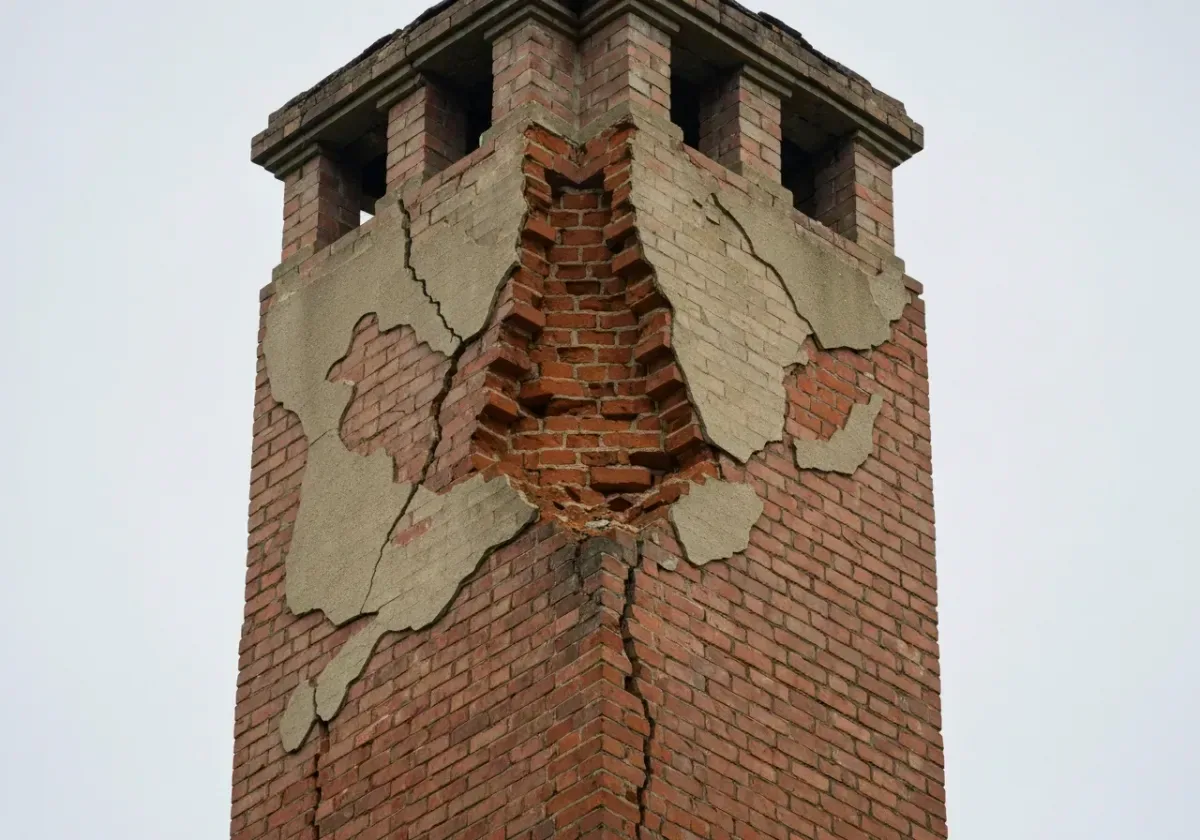 Before
 After
 Before
 After
 Before
 After
Four steps, each one on paper — so you always know what happens next.
Choose a genuine opening on the crew's calendar. Confirmation is immediate.
Liner, crown, cap, flashing and masonry examined in order — each finding photographed.
One document, plain numbers, covering only the work your chimney genuinely needs.
The repair is completed, then handed over with before-and-after photos of every item.
$99 plus tax, charged per chimney. That buys an on-site camera survey and a report you keep. If you then approve a quote from us, $99 is deducted from that work. Should you decline, the $99 stays paid for the visit.
It depends on the work. Repointing a chimney is on the city's list of jobs that skip a building permit (Seattle Residential Code, R105.2). For larger jobs no city page we read gives a chimney-specific rule, so we ask SDCI about your address rather than assert one.
The 2022 landmark nomination for Alki Elementary lists the Fauntleroy Schoolhouse among historically significant West Seattle properties. Exterior changes to a designated Seattle landmark need a Certificate of Approval; that rule concerns designated buildings, not ordinary houses nearby.
It can. A tall stack on the downhill face of a house, or a roof that cannot be walked, needs more setup. We look at access during the inspection so the quote already accounts for it.
Choose a genuine opening on the crew's calendar. We inspect, quote in writing, and hand over a photo record of every repair.