A Level 2 inspection is the visit for a chimney whose condition you cannot take on trust. It keeps everything in a routine look at the firebox and the outside of the stack, and adds three things: a camera run through the full length of the flue, a check of the chimney where it passes through the attic and the crawl space, and measurements taken on the roof and at the hearth. Nothing is opened up or dismantled. You come away with photographs, the camera footage and a report in plain words on the condition of each part. The sections below say when that visit is the right one in West Seattle and what each part of it looks at.
When the fuller visit is the right one
NFPA 211, as CSIA quotes it, sets a yearly inspection as the minimum for chimneys, fireplaces and vents. For a flue that has been looked at regularly and has not changed, the routine check does that job. The fuller visit is for the situations in the table, where something is new, unknown or may have moved.
The first row comes up constantly here. In the Census ZIP code area covering Fauntleroy, Gatewood and the southern end of Seaview, the median home dates from 1960 and 30.1 percent of housing units were built before 1940. A chimney of that age has usually passed through several owners, and the seller's memory of it goes back only so far.
| Situation | What is uncertain | What the Level 2 adds |
|---|---|---|
| The house is being bought or sold | Decades of use nobody can vouch for | A recording of the whole flue, for both parties |
| An insert or stove is going in, or the fuel is changing | Whether the flue suits the new appliance | Liner type, size and condition, measured |
| The flue is about to be relined | What the new liner will be fitted into | Offsets, obstructions and damaged tiles located |
| There has been a chimney fire | Heat damage hidden behind the soot | Tile-by-tile camera footage after sweeping |
| An earthquake, or a tree or limb onto the roof | Cracks and shifts above and below the roofline | Attic and crawl space checks, plus the camera |
| A leak or smoke problem with no visible cause | Where the fault actually is | The concealed parts a routine look never reaches |
Why earthquakes weigh so heavily here
West Seattle's chimneys have a documented history that most places lack. After the earthquake of April 29, 1965, a survey of 188 city blocks in West Seattle counted 5,005 chimneys and found 1,712 of them damaged, which is 34 percent, according to HistoryLink. After the Nisqually earthquake of 2001, Booth, Wells and Givler surveyed roughly 60,000 chimneys across the greater Seattle area and recorded 1,556 with visible damage. Their paper reports that the damage was strongly clustered, in West Seattle above all, and that it fell away sharply over a block or two at the edge of the affected zones.
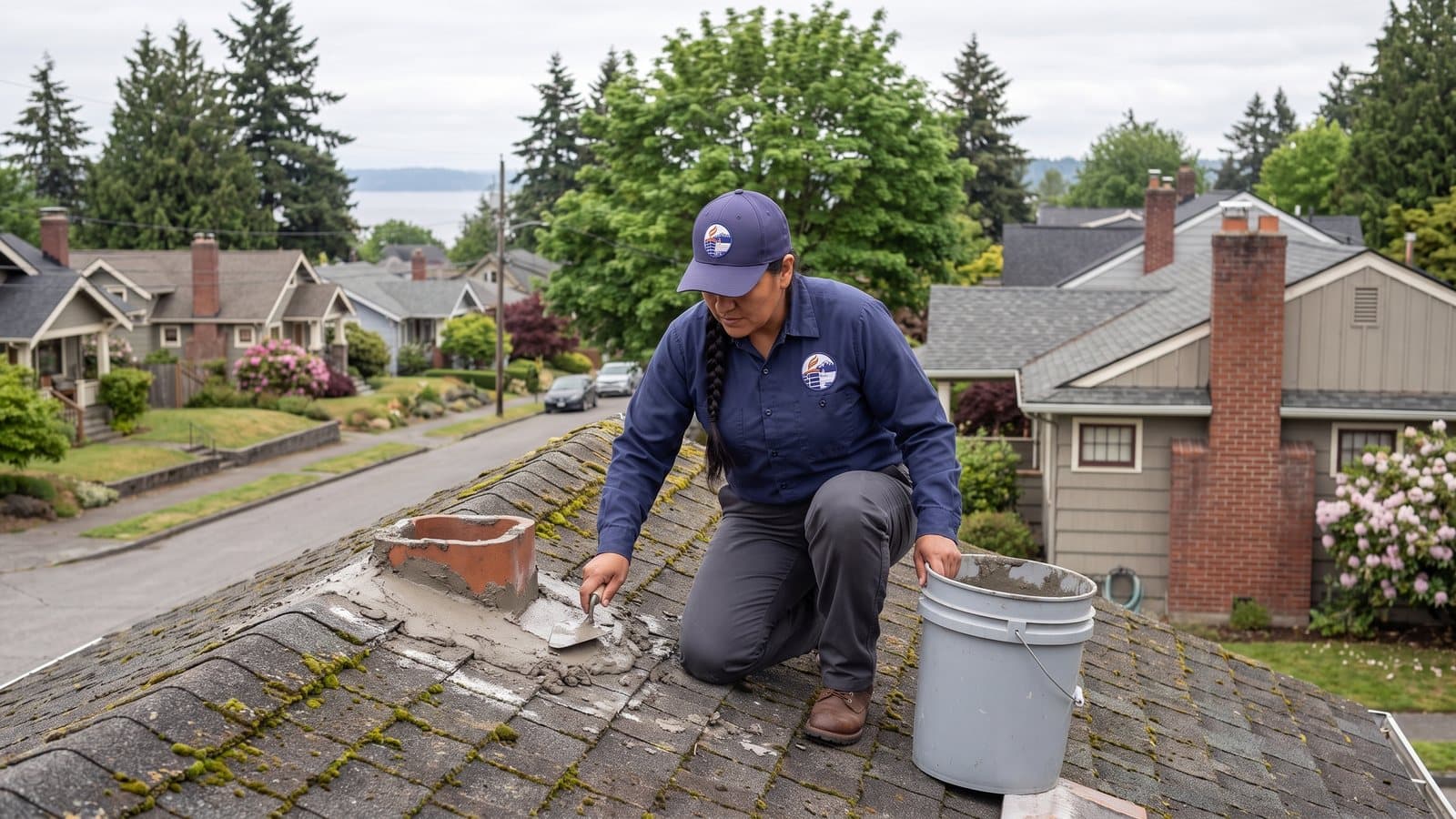
Two practical points follow. A neighbor's intact chimney says little about yours, since the pattern changed within a couple of blocks. And a stack that was damaged in 1965 or 2001 was repaired by someone, to a standard nobody recorded. A FEMA advisory on earthquake-damaged masonry chimneys cautions against putting a fallen stack back exactly as it was, since the copy is no stronger than the original. During the visit we look for the traces of an old repair: a change of brick or mortar at the roofline, a lean, a rebuilt top on an original base.
On the roof and through the house
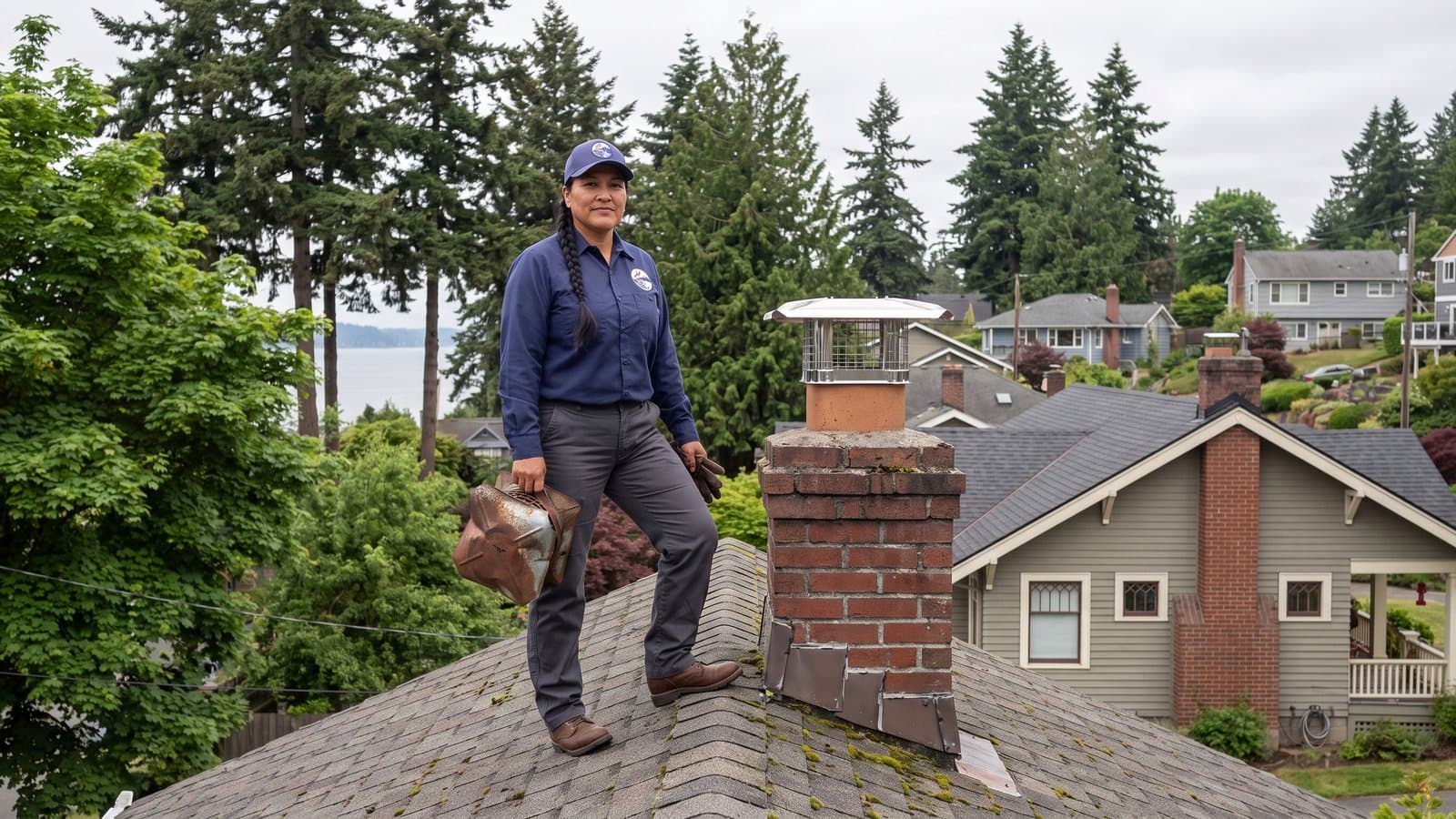
Up top, the cap, the crown, the brick faces and the flashing are examined and photographed, and the height of the stack is measured. Section R1003.9 of the 2021 Seattle Residential Code gives two figures: the chimney must rise 3 feet or more above the high side of the place where it comes through the roof, and it must clear by at least 2 feet whatever part of the building lies less than 10 feet away. An addition or a raised roofline nearby can leave an older chimney short of the second figure, and a short chimney tends to draw badly in wind.
Indoors, we follow the stack through every space that can be entered. In the attic we check the masonry for cracks and water tracks and measure the gap to the wood framing. Washington's residential code, the base text of Seattle's, asks for 2 inches of clearance to combustibles for a chimney inside the building or within its exterior wall, and 1 inch for a chimney that stands wholly outside. In the crawl space we look at the base, the ash pit and the cleanout for settlement and damp.
Inside the flue
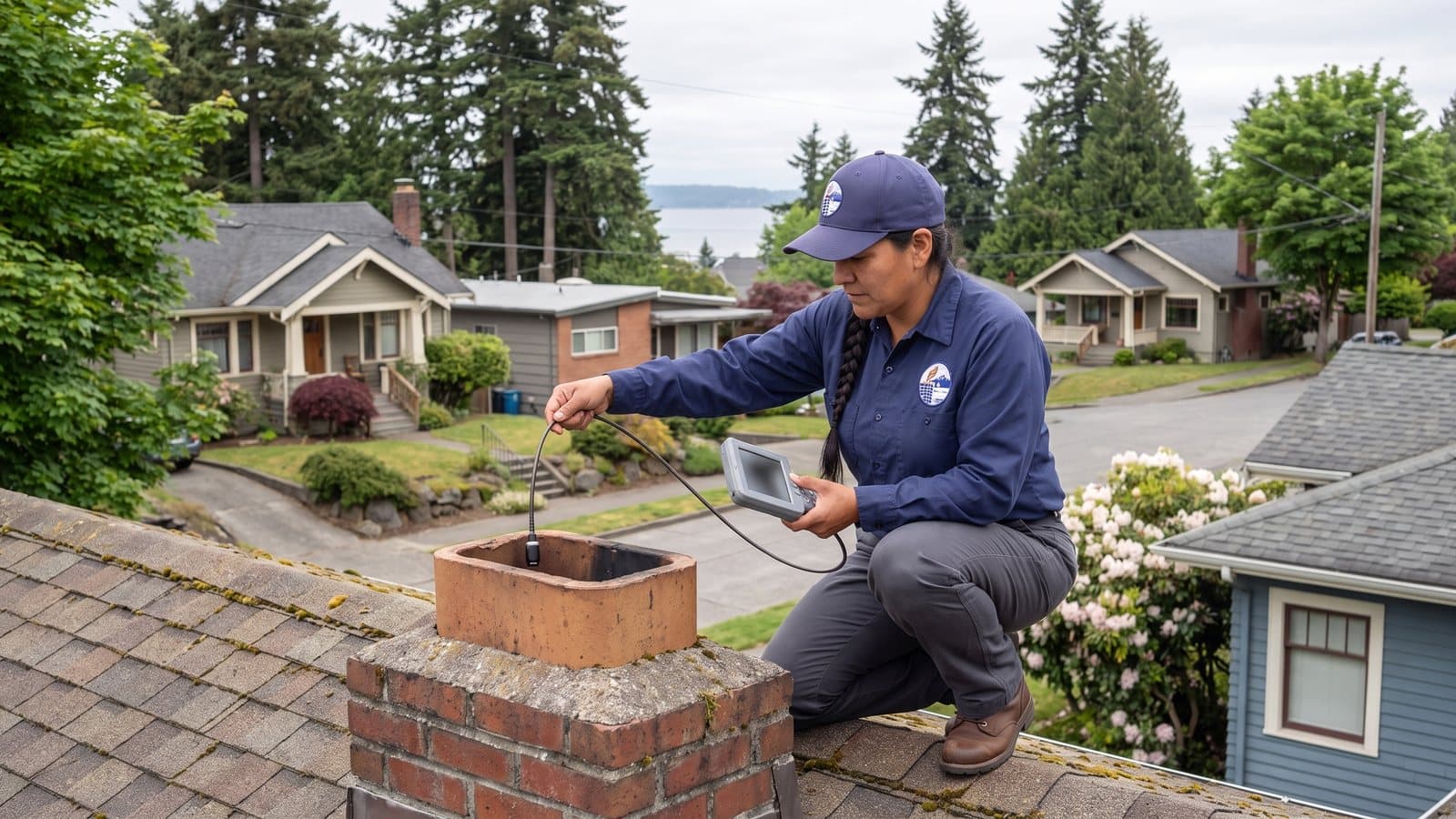
The camera travels from firebox to cap on a rod, recording as it goes. On a clay tile flue it shows each tile and each joint: cracks, gaps where mortar has dropped out, tiles that have shifted out of line, glazed deposits, anything lodged in the passage. On a metal liner it shows seams, dents and corrosion.
We also note what the flue is lined with. For masonry chimneys the state code names clay tile, listed liner systems, factory-built chimney units and other approved materials able to withstand 1,800°F. An unlined flue, or one lined with something else, is written up as such, because it decides what can safely be connected to it.
At the hearth
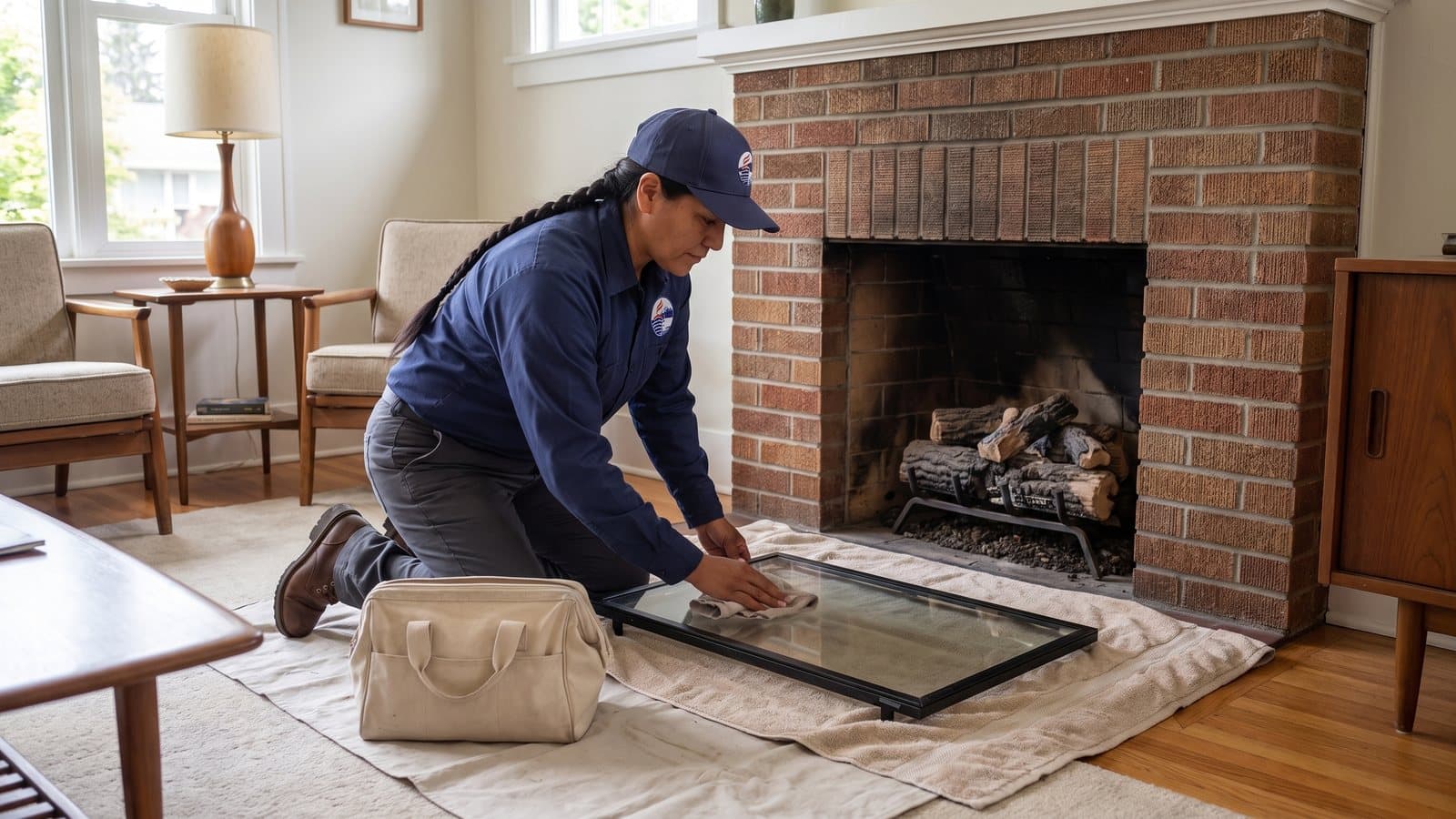
The last measurements are taken in the room. The code's hearth extension reaches 16 inches or more in front of the fireplace opening and 8 inches or more past each side, and those become 20 and 12 inches once the opening measures 6 square feet. Around a masonry fireplace, wood and other combustibles keep their distance: 2 inches at the front faces and the sides, 4 inches behind.
The damper is worked by hand. Washington's amendment for masonry fireplaces calls for a damper of ferrous metal, mounted no less than 8 inches higher than the opening's top edge, that can be worked from the room. The firebox walls and the smoke chamber above them are checked for cracks and missing mortar.
The report and the fee
You receive the photographs, the flue recording and a written report that takes the chimney part by part. Where a repair is needed, a written quote comes with it, and each defect is located so that another contractor could find it too.
We charge $99 plus tax to inspect one chimney, with the camera run included; and a repair quote you accept is reduced by the same $99. As a point of comparison, Jason L. Chimney Co., a company listing an address on SW Admiral Way, prices a Level 2 inspection with camera at $250 to $400 on its pricing page.
Frequently asked questions
Is anything taken apart during a Level 2 inspection?
No. The visit uses the access the house already has: the roof, the attic hatch, the crawl space door, the cleanout and the firebox. The camera does the rest. Opening a wall or removing part of the chimney to reach a hidden defect is a different, rarer kind of inspection, and we would explain why before proposing it.
Will the report say whether my chimney is reinforced against earthquakes?
It will say what can be seen. Where the stack passes a floor or roof line we look for the steel straps that Seattle's code requires of new or rebuilt masonry chimneys on sites the code places in a D seismic design category (D0, D1 or D2). We do not assign a seismic category to your address, and steel inside the masonry cannot be confirmed by eye. Adding reinforcement is structural work that we refer out.
A measurement in the report does not match today's code. Do I have to change it?
Not automatically. A fireplace built under an older code is recorded as it stands, with the current figure beside it for reference. The numbers start to matter when something is altered, for instance a mantel replaced, the floor redone at the hearth, an insert added. For any work that follows, SDCI gets our permit question before a date is set.
How should I get the house ready?
Let the fireplace go cold for a full day. Move furniture and rugs back from the hearth, and clear a path to the attic hatch and to the crawl space door. If the report is for a sale, tell us who else should receive a copy.
Sources
- CSIA — resources for homeowners (NFPA 211) — accessed October 4, 2026
- Census Reporter — ACS 2020–2024, year built by ZIP area — accessed October 4, 2026
- HistoryLink — the April 29, 1965 earthquake — accessed October 4, 2026
- USGS — Booth, Wells & Givler (2004), chimney damage study — accessed October 4, 2026
- FEMA — Recovery Advisory DR-4193-RA1, masonry chimneys — accessed October 4, 2026
- 2021 Seattle Residential Code — Chapter 10 PDF — accessed October 4, 2026
- UpCodes — WA Residential Code 2021, Chapter 10 — accessed October 4, 2026
- WAC 51-51-1001 (Cornell LII) — accessed October 4, 2026
- Jason L. Chimney Co. — pricing guide — accessed October 4, 2026
Related services