A gas fireplace asks for less than a wood one, which is exactly why its upkeep gets skipped. There is no ash to carry out and no smoke to remind you. The work divides cleanly in two: a short list of things the owner can do with the unit switched off and cold, and a yearly service by a technician who opens the burner compartment and tests the safety devices. The checklist below sets out both halves, then covers the Seattle rules for gas units and what a tune-up runs in West Seattle.
How common gas is on the peninsula
Each household in the American Community Survey names the fuel it mainly heats with. Across Seattle, 32.8 percent of occupied homes answer utility gas. In the five Census ZIP code areas that take in West Seattle, the share runs from 30.5 percent in the one around Delridge to 41.9 percent in the one that includes Gatewood and Fauntleroy.
Those figures describe furnaces and boilers, not fireplaces; the survey does not count hearths of any kind. They do show that gas service reaches a large share of the peninsula's houses, and where there is a gas meter there is often a gas fireplace, an insert or a log set on the same line.
The checklist
Each line names who does the task and when. Anything that involves the burner, the pilot assembly, the gas valve or the venting belongs to the technician. The owner's manual for your model takes precedence over this table wherever the two differ.
The technician's lines match what Seattle-area companies publish as the content of a tune-up. Mad Hatter Chimney Sweep lists three parts to its gas fireplace service: cleaning the burner, checking the vent, inspecting the pilot. AAA Fireplace lists cleaning of the burner and the glass, tests of the thermocouple and the thermopile, and checks of the gas valve and the venting.
| Task | Who | When |
|---|---|---|
| Watch the flame and note any change in its shape, color or sound | Owner | Each time the unit is lit |
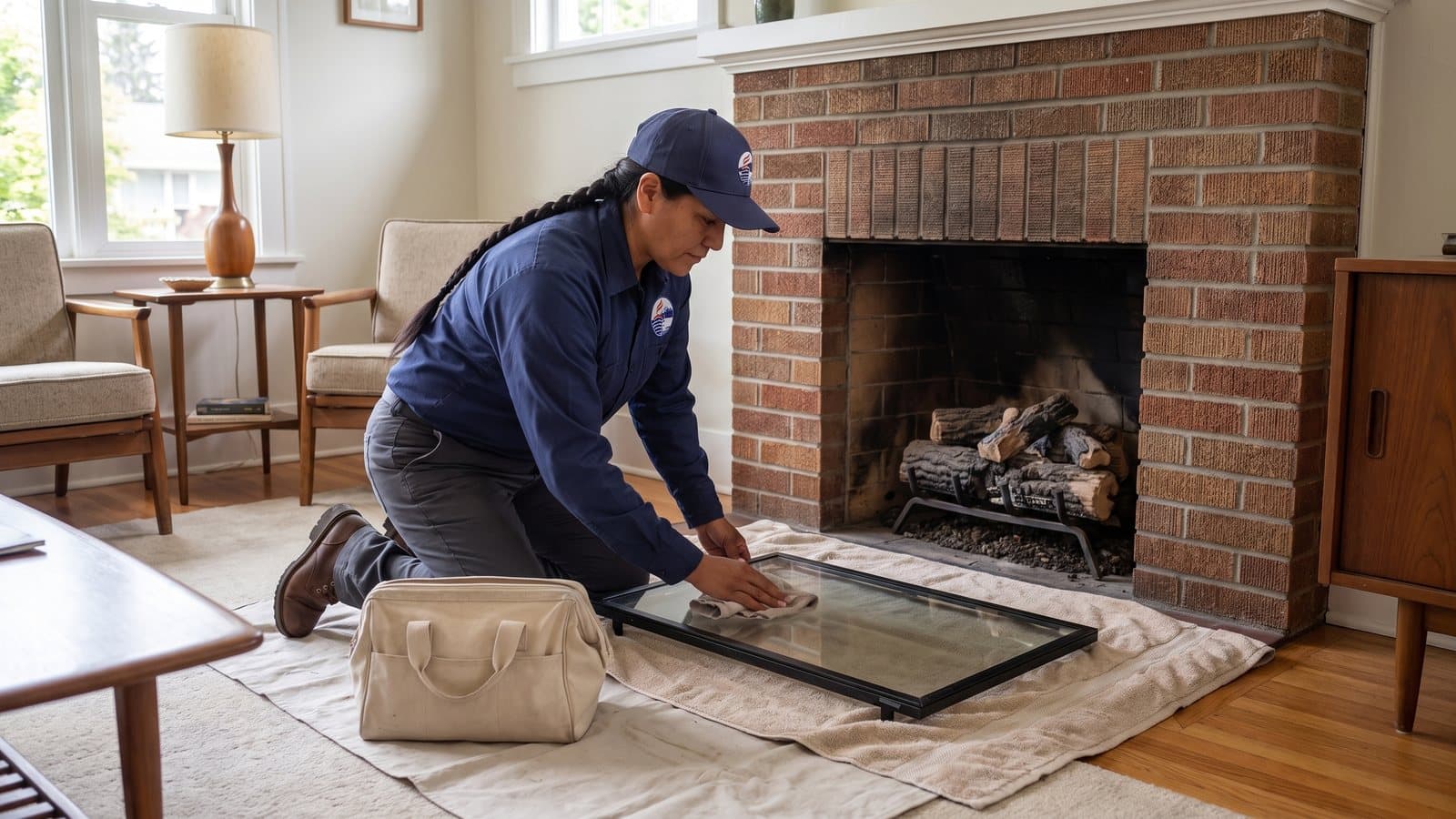
| Clean the glass, with the unit off and fully cold, using a cleaner the manual allows | Owner | When a film appears |
| Keep the outside vent termination clear of leaves, shrubs and nests | Owner | In fall and after each windstorm |
| Replace the batteries in the remote and the receiver | Owner | Before the cool season |
| Test the carbon monoxide alarms in the house | Owner | On the schedule printed on the alarm |
| Clean the burner and the pilot assembly; reset logs and embers to the maker's layout | Technician | Yearly |
| Test the thermocouple, the thermopile and the gas valve | Technician | Yearly |
| Check the venting from the unit to its termination, and the glass gasket | Technician | Yearly |
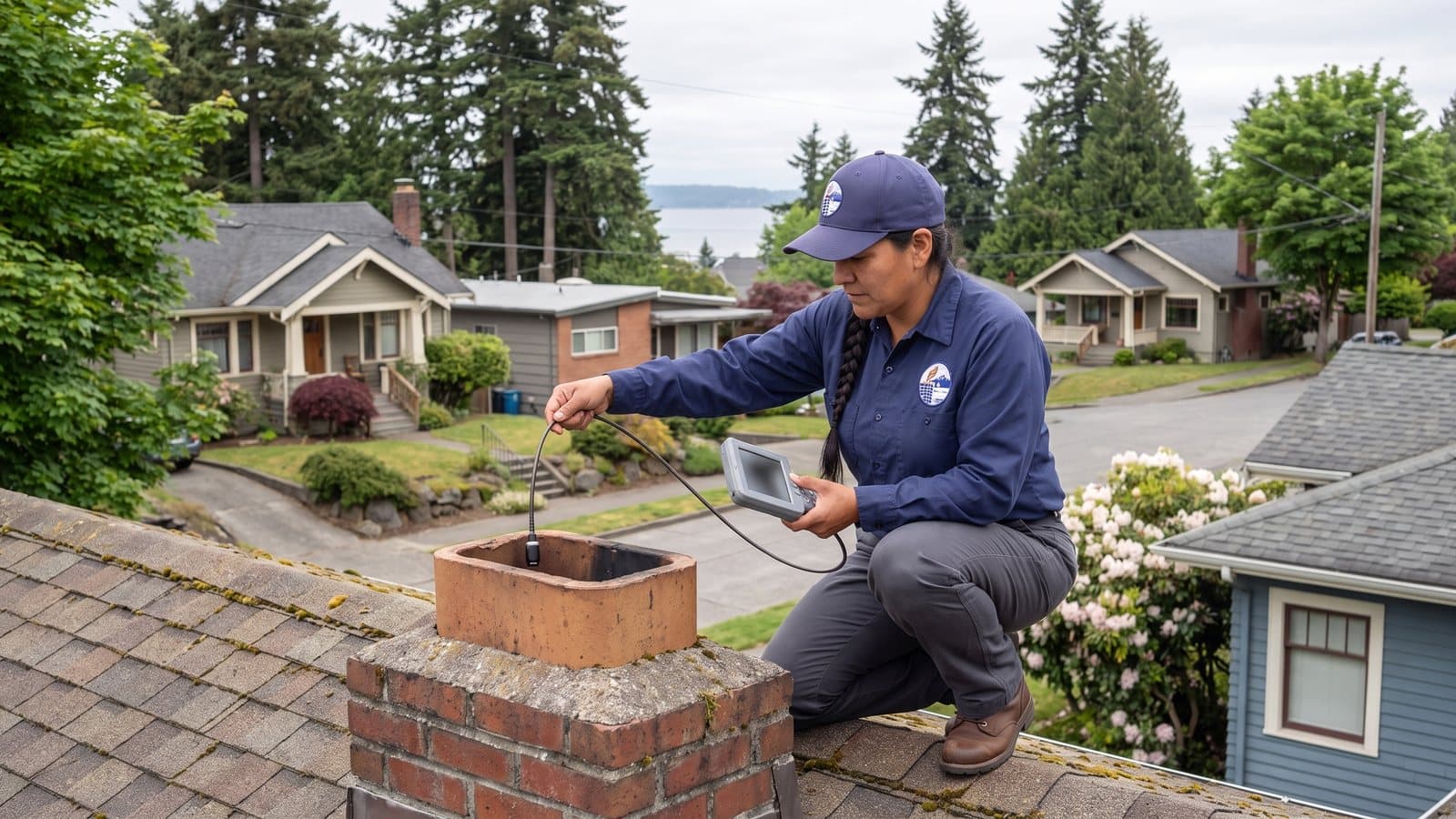
| Inspect the chimney flue, damper and cap when gas logs sit in a masonry fireplace | Technician | Yearly |
Why the yearly visit applies to gas too
The standard that CSIA quotes, NFPA 211, does not single out wood. Its yearly inspection covers three things by name: chimneys, fireplaces and vents. A gas vent can be blocked by a nest, pulled apart at a joint or corroded through without leaving a trace in the room.
The safety devices are the other reason. A thermocouple or thermopile is what shuts the gas off when the pilot goes out, and it weakens gradually. Testing it takes a meter and a few minutes. Finding out that it has failed takes a cold evening and a unit that will not stay lit, or worse, one that should have shut down and did not.
Seattle rules that touch gas units
Two code points come up regularly. The 2021 Seattle Mechanical Code does not allow an unvented gas log heater in a factory-built fireplace unless that fireplace is listed for one, so not every metal firebox may receive a log set. The same chapter requires a fireplace insert to be listed, labeled and installed as its manufacturer directs, which is why we ask for the model number before a visit.
On permits, the mechanical permit SDCI issues is for heating and venting equipment being newly installed, and it leaves gas lines out; gas piping needs its own permit. The residential code's exemption list covers swapping a component when the system's original approval is unchanged. We state nothing beyond those two readings, and for a new installation we ask SDCI about the permit before any work is scheduled.
Storm season: the reason to service it in early fall
On WeatherSpark's Seattle profile, the stronger winds run from mid-October (the 15th) until April 24. The city's hazard analysis recalls what a bad one does: in December 2006 nearly half of City Light's customers (49 percent) were cut off, and the last of them waited a week for the lights to return. The same document reports deaths in King County among people who burned charcoal indoors for warmth.
Many gas fireplaces can light without household power, and many cannot. Read your manual, or ask at the service visit, and learn the answer before the first outage. If yours does run on its own, a serviced unit with a tested vent is a sound way to keep one room warm. Whatever the heat source, working carbon monoxide alarms are not optional.
What a tune-up runs
Our gas fireplace service is $189 to $475, depending on the type of unit and what the visit involves. A repair that needs parts is quoted in writing before it is carried out. When gas logs sit in a masonry fireplace and the chimney itself needs looking at, the chimney inspection is $99 plus tax, an amount subtracted from the quote if you approve it.
Published prices from three companies that serve Seattle: Mad Hatter Chimney Sweep's gas service is shown at $150 to $275. AAA Fireplace, a King County company, advertises a flat $299 annual tune-up. Washington Energy Services lists a 13-point tune-up at $259 for specific brands and for units it installed, and does not serve condos or multi-family buildings.
Frequently asked questions
Should a gas fireplace be swept like a wood one?
It needs a yearly inspection more than a brushing. Gas leaves very little soot, so there is seldom much to sweep. The exception is a gas log set installed in a masonry fireplace: it exhausts through the original brick chimney, and that flue, its damper and its cap need the same yearly look as any other.
What should I do if I smell gas near the fireplace?
Do not light the unit and do not operate switches. Get everyone out of the house, then call your gas utility's emergency line or 911 from outside. A fireplace technician comes afterwards, once the utility has made the supply safe.
Can a gas fireplace be used during an air quality burn ban?
Both stages of a ban, in the regional Clean Air Agency's own description, target wood smoke. Every device on their lists is fed with cordwood or pellets. Check the agency's burn ban status page on the day for the exact terms in force.
Does replacing a part on a gas fireplace need a permit in Seattle?
Seattle's residential code, at R105.2, exempts replacing a component of a mechanical system when the swap does not alter the system's original approval. New gas piping is another matter: SDCI's mechanical permit does not cover gas lines, which take a separate permit. For anything beyond a like-for-like part, the permit question goes to SDCI first.
Sources
- Census Reporter — ACS 2020–2024 table B25040 — accessed October 4, 2026
- CSIA — homeowner resources — accessed October 4, 2026
- 2021 Seattle Mechanical Code, Chapter 9 (SDCI) — accessed October 4, 2026
- SDCI — mechanical permit page — accessed October 4, 2026
- Seattle Residential Code 2021, Chapter 1 (R105.2) — accessed October 4, 2026
- City of Seattle — windstorm hazard chapter — accessed October 4, 2026
- Clean Air Agency — about air quality bans — accessed October 4, 2026
- WeatherSpark — Seattle wind and seasons — accessed October 4, 2026
- Mad Hatter Chimney Sweep — cost guide for Seattle — accessed October 4, 2026
- AAA Fireplace — gas tune-up page — accessed October 4, 2026
- Washington Energy Services — insert tune-up — accessed October 4, 2026
Related services